Bootstrap
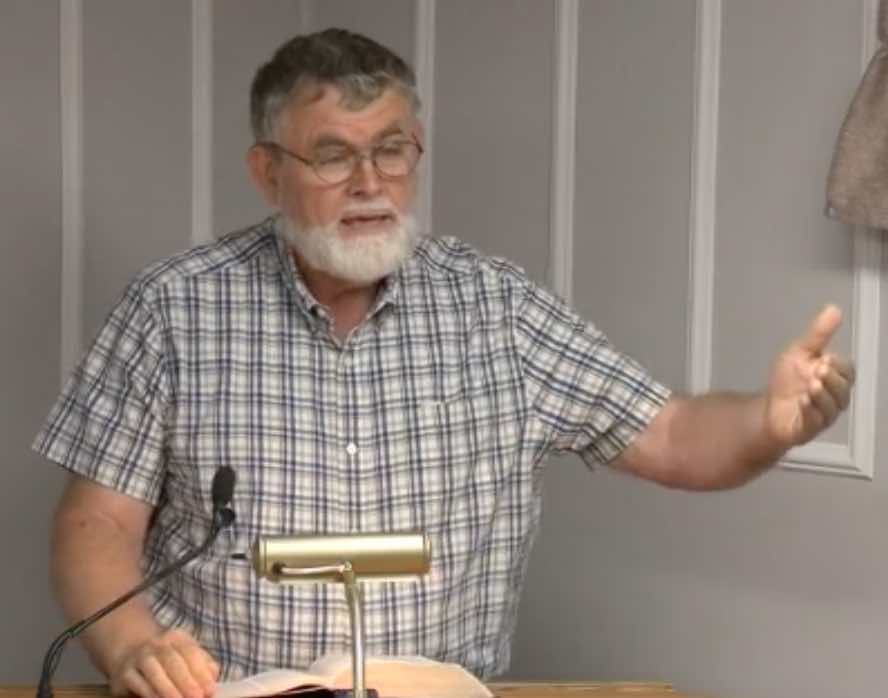
Mike McInnis

The Common Faith

Titus 1
Mike McInnis November, 5 2023 Audio
0 Comments
Titus Series

In the sermon titled "The Common Faith," Mike McInnis explores the doctrine of the sovereign grace of God in evangelism and preaching as manifested in Paul's letter to Titus. He emphasizes that God uniquely calls men to specific ministries, highlighting the divine orchestration in the preaching of the gospel. Throughout the sermon, McInnis references Titus 1:4-5, underscoring that Paul, a divinely appointed apostle, instructs Titus on establishing order within the early church, thus affirming the necessity of divinely appointed leadership. The practical significance of these doctrines emphasizes that true faith is centered on Jesus Christ, the common faith of all believers, which cannot be derived from human effort or understanding but is a gift from God that transforms lives.

Key Quotes

“The preaching of the gospel has no power at all apart from the grace of God to send that word and cause it to be heard.”

“The common faith is that we have no value of our own in bringing anything to Him; that we're sinners in need of a Savior. And Christ is that Savior.”

“When the Lord would have something to be done, it will be done according to the order and the method that he determines for it to be done.”

“The truth is the truth. But when the truth is contrasted with error, it shines in a very bright light.”

Sermon Transcript

Auto-generated transcript • May contain errors

100%
In the book of Titus, looking
in the first chapter, Paul's letter to Titus, as he says in
verse four, to Titus, my own son, after the common faith. Grace, mercy, and peace from
God the Father and the Lord Jesus Christ, our Savior. Now there's a lot contained in
that one verse there, And we may look at some other verses
also, but to Titus, my own son, after the common faith. Paul, of course, was called to
a particular ministry, as are all of those whom the Lord calls. The Lord doesn't call men to
a general And then, in other words, he doesn't just call men
to go do something and then he goes and takes a nap while they
go about doing what they're doing. The Lord sends men on a specific
mission for a specific time to a specific people. And they will
perform that. They will not neglect it, they
cannot, if the Lord sends them. As I've said to you many times,
Jonah's a good example of that. When the Lord sends a man, he'll
go. Now there's a lot of men that
run when they have not been sent, for sure. That is the way of
men. Men think they can do whatever
they want to do. And in a measure, as men look
at it, that might be true, as far as what they think. But the truth of the matter is
that when the Lord would have something to be done, it will
be done. And it will be done according
to the order and the method that he determines for it to be done.
and the order and the method by which he has been pleased
in the present time to call unto his people to make known to them
the truth is through the preaching of the gospel and that's a glorious
thing. Now it is a true thing that everything
that is true there is a a falsehood. To everything that's
true there's a swerving. And there are some that would
present the gospel or present the preaching of the gospel as
though it in itself has power. Now the preaching of the gospel
has no power at all. apart from the grace of God to
send that word and cause it to be heard. But when the Lord is
pleased to send the word and cause the word to be heard, then
great power is demonstrated. And we see that on the day of
Pentecost. Now if you listen to what most
people say, a lot of people just go to seed on Pentecost. They
think that's just the be all and end all and the things that
occurred on Pentecost they try to duplicate, they try to say
well this is supposed to continue on. The day of Pentecost was
a particular day. It's never been repeated because
it had a specific purpose. God sent that according to the
good pleasure of his will because he would declare through Peter
on that day the unfolding of the gospel of Jesus Christ. Now
Peter preached with great power that day. How do we know that? Peter did not preach with great
power because he was Peter. Now he was a very capable man. He was a strong man. He was a man of great conviction.
But Peter, up until that point, was not a man prepared to preach
the gospel. He knew what it was. He told
the Lord. When the Lord said, will you
go away from me? And he said, Lord, to whom shall
we go? Thou hast the words of eternal
life, and we believe and are sure that thou art the Christ,
the Son of the living God. And the Lord said to him, Peter,
flesh and blood hath not revealed this unto you, but my Father
which is in heaven. But Peter wasn't ready to preach
the gospel. The Lord didn't send him to preach
the gospel because, at that point in time, because he, the Lord
said, well, it's necessary that the Son of Man must be crucified.
And Peter said, oh no, Lord. No, you can't win, that's not
going to happen. Right after he had said what
he said, the Lord said, he revealed this to him, he said, get thee
behind me, Satan. For thou savest not the things
that be of God. Now that's an amazing thing if
you pause and think about it, is it not? You see, the Lord
had indeed ordained that Peter would preach the gospel on the
day of Pentecost, but Peter wasn't ready to preach the gospel, because
the Lord hadn't seen him at that time, because Peter had to learn
a lesson, did he not? He said, Lord, though all men
forsake thee, I won't, as I'll stand with you to the death.
The Lord looked on him, and I'm sure he looked on him with love,
and he said, Peter, he said this very night, before the cock crows,
you shall deny me three times. And he said, but I have prayed
for thee, that thy faith fail not. Because you see, the Lord
was going to use Peter, not because he was Peter, Not because Peter
had any power. Not because Peter had any strong
will. He thought he did. And he did
in the flesh. But see, that's not what it takes.
The Lord's not, you know, sometimes people think, well, you know,
the Lord's out here looking, and when he finds somebody that
can really talk, you know, he can, a lot of preachers used
to talk about they could really shell the corn. I mean, you know,
they can come up with a good outline, and they can cause people's
shirttail to run up and down their back like a wind of shade,
and they can keep everybody entranced with their words, and all of
those sort of things. that are all in the flesh. I
mean, there's great orators. The Lord has sent men into the
world as great orators. I mean, Apollos, he was a great
orator, but he didn't know the gospel until the Lord sent somebody
to him and told him. And then, you see, the Lord used
Apollos, not because he was Apollos, but because the Lord would send
him. And so it is. That Paul was a
man who was sent by the Lord to preach the gospel. Even as
we see Peter on the day of Pentecost, remember what the Lord said to
Peter when he talked to him and he asked him three times, Peter,
do you love me? And Peter said, Lord, you know
that I love you. And he said, well, Peter, when
thou art converted, when you were changed. Now that caused
a lot of people a lot of consternation. You see the Lord is, He is the
author of conversion. Now people talk about, well I
converted. I was reading the other day about
somebody and they were talking about some religion that they
had embraced. I don't even remember if it was
Christianity or something. They said we converted as if
we did something. Well, I'm telling you this, you
can't convert. And Peter wasn't able to convert. The Lord didn't say, now Peter,
I want you to convert yourself. No, he said, Peter, when you
are converted, when you are changed, feed my sheep. Well, when did
that happen? Happened on the day of Pentecost.
I don't know what it was. The Lord came upon them. The
Lord said He would visit them, and He did. He came upon them,
and they preached the Word of God boldly. But as many, you
know, they think of the day of Pentecost and they talk about
the gift of tongues and they talk about this miraculous thing
that took place. And they say, oh man, this was
great. All these people got up there and they was babbling away.
And that's just a wonderful thing. Cause I mean, if you, if the
spirit of God comes on you, you just gonna babble away. That's
just what happens. Well, the miracle that day was
not that men spoke in other tongues. That was not it. The miracle
that took place that day was that men heard in their own tongue. Now that's the glorious thing,
because you see, the only way that the Lord, that a man can
hear in his own tongue, that is with understanding, is for
the Lord to send that word. Because you can sit under preaching
all your life. I've known of people, I was raised
among a people, and many of them sat and heard preaching all their
life, but they never heard the gospel. They never heard the
word of God. It never came upon their heart
and mind in such a way that they understood that Christ is the
King of kings, the Lord of lords, the one who's worthy of all glory
and praise. You see, that's what happened
With Peter that day, was it not? He said, this man whom you have
crucified, he said, he's the one that I'm preaching today. And the scripture says that there
were 3,000 souls that believed that day. Now why did they believe? Because they heard. Now there
was more than 3,000 people there, but there was 3,000 that believed.
Now, didn't they all hear the same thing? I mean, wasn't it
the same preacher? Of course it was. But what made
the difference? The power of God. He came upon
them that day, and they heard the word. And they were, the
scripture says they were pricked in their hearts. And they said,
then brethren, what shall we do? See, that's what happens
when the Lord awakens a man. He says, oh, woe is me. What
can I do? What now? See, everything was
going along all right. I wasn't having any problems.
And all of a sudden, wow, I got trouble. And so Paul speaks to Titus,
my own son. Now, he wasn't his natural son,
of course, but he was a convert. One whom the Lord had converted
to hear the gospel and believe it. Through the preaching of
Paul to Titus, my own son. I started off by, I said that
preaching, you know, sometimes it gets confused in the minds of some,
and they make preaching to be something that it's not. It's
not the power of the preacher. but it's the power of God in
the message that's preached. And if the power of God is not
in the message that's preached, it'll roll off the backs of men
like water off a duck's back. But when God sends it for a specific
purpose, it will accomplish that purpose. The word of God shall
not return unto him void, that is empty, but it will accomplish
that thing where to he sends it every time. And that's the
reason why we're not ashamed or afraid to declare the same
truth to every man. Because we know that the Lord
will take that and he will accomplish exactly what he sets out to do.
And it will be to some a savor of life, and to life and to others
it'll be a savor of death. It won't mean anything to them
at all, but just another nail in their coffin. my own son after the common faith. Now does that mean that it is
of little value? You know, if something's common,
that's not what he means here. That it's not of little value,
but it's common in that it is the same faith that is universal
among all who believe. And what is that faith? We talk
about it all the time. What is that faith? It's Christ.
Christ is all. He is our faith. The common faith,
you see, is where men believe in Christ. Now that seems like
a simple thing, and it is on the one hand, but it's the most
profound thing that can ever happen, because when a man has
faith in Christ, he has faith in nothing else. He loses all
faith in anything else. He looks at his deeds and he
says, man, that's dumb, that's nothing. I need Christ. He says, Paul says that I might
win Christ, that I might know him and the power of his resurrection. Sirs, we would see Jesus. We
need to know him. We need for His Word to take
root in our heart. We need to learn of Him. See,
that's the common faith of God's people. Now, all of God's people
are not able to spout out all the various nuances of theology. I'm not. You know, I get around
to listen to some guys and I feel how ignorant I am. But you know what? The common
faith is not a doctrinal scheme. It's not a certain number of
points in an outline. The common faith is Jesus Christ
and Him crucified. The common faith is that we have
no value of our own in bringing anything to Him, that we're sinners
in need of a Savior. And Christ is that Savior. See, that's the glorious truth
of the gospel, is Christ is the Savior. Now, the only ones that
that appeals to is those that know themselves to be sinners.
If a man thinks he has some righteousness, well, Christ died on the cross,
okay. That's okay. But you see, a sinner,
that's his only hope. I mean, it's not like that's
one alternative or that he says, well, maybe I'll believe, I'll
believe a little bit, but you know, I don't wanna get too far
into this. I don't wanna overcommit. No,
he's hungry, he's thirsting, he's needy. And Christ is the
solution to that need. Christ is the common faith. Grace, mercy, and peace from
God the Father and the Lord Jesus Christ, our Savior. You know, We could spend a lot of time,
and men often do, trying to explain the mystery of God the Father,
God the Son, and God the Holy Ghost. I'm not gonna spend any time.
I'm gonna tell you, go read what the Bible says about it. I'm
not interested in anybody's theory on it. I've read enough theories
about it, and I've gained some benefit from reading all the
things that I've read. But I have to come back to this
and read it, and I just say, you know, that's a wonder. I'm
not meant to understand it. I'm not meant to explain it.
I can't explain it. You tell me how it is. I mean,
the Lord when he walked among his disciples. I mean, even his
disciples, they didn't understand this, did they? I mean, Philip
said, Lord, you know, show us the Father and it'll suffice
us. He said, Philip, have I been so long time with you and you
have not known me? He said, he that has seen me
has seen the Father. That passage that Brother Al
read there a moment ago about the counselor. His name shall
be called Wonderful, the Mighty God. He shall be called the Father,
the Prince of Peace, the Everlasting One. And so it is that when he
says, grace, mercy, and peace from God the Father and the Lord
Jesus Christ our Savior, he's not talking about two different
entities. Folks, we don't worship multiple
gods, we have one God. and he has shown himself to us
in the person of Jesus Christ. No man has seen God at any time. That's why Manoah was so fearful. He said, well, we're gonna die
because it's impossible to see God and live. And it is. And you could never
know God. apart from the fact that he has
revealed himself in Jesus Christ. Only way you'll ever know him.
You know, you, when you, some people I think think that when
they get to heaven, there's gonna be like three thrones sitting
up there. No, there's one throne. And his name, the one whose name
is above every name is seated on that throne. Oh, what a glorious
God He is. Grace, mercy, and peace from
God the Father and the Lord Jesus Christ our Savior. Because you
see, we'd never have known God the Father apart from knowing
Jesus Christ. And we'd never have any understanding
of these things were it not that He had sent His Spirit. to guide
us, to direct us, to show us, to teach us. That's what he said,
did he not? He said, he will lead you into
all truth. Well, what did he say? He said, he'll not testify
of himself, but he shall speak of me. And so that's what we
preach, is that Christ is that one who's worthy to be praised.
He is that one who gives us peace He's that one who directs us
in our way. Thanks be unto the Lord. Now
he goes on here and I'll read these verses. I might make a
few comments on them. For this cause left I thee in
Crete that thou should set in order things that are wanting
and ordain elders in every city as I had appointed thee. Now
keep in mind that this is the beginning of gospel churches. I mean, before Paul and Peter
and these various disciples went out preaching the gospel, I mean,
you wouldn't went down to Corinth and found a church. It was no such thing. I mean,
these people were living in pagan darkness. They didn't know anything.
But God, who's rich in mercy, he sent the gospel, and some
believed. And so you have all these different
places where the gospel's being preached, and believers have
come out of the woodwork. And they've been baptized, and
they're gathering together, but it's kind of a hodgepodge of
things. I mean, nobody knows anything. They couldn't go down to the
bookstore and buy them a Bible, because there wasn't one. So
it was quite a different situation that was taking place at that
time than what we see in the present time. And so I think
we need to understand these things in light of that. Now I'm not,
you know, I don't want to get off in the weeds here on this,
but to understand that it was necessary what Titus was sent
to do. And notice this, that Paul gave
him the direction. Titus didn't set out to do this
on his own. He did it at the direction of
Paul, and Paul was an apostle sent by God with authority. to
do these things. And so he sent Titus to set in
order things that are needful, things that are wanting, and
ordain elders in every city as I had appointed thee. He needed
to ordain overseers because they couldn't be there. I mean, just
like the Lord sent the Holy Spirit to guide His people, when He
was no longer with them, Paul said, look, we're not going to
always be here in the midst of these people. And the Lord will
raise up men to carry these things on. You need to go and find them.
See, He didn't say go make them. He said set them apart. Because
He already said, how are you going to know them? And he tells
her, how are you going to know him? He says, if any be blameless,
the husband of one wife, having faithful children, not accused
of riot or unruly. Now that couldn't be said of
everybody, could it? Now he's talking about new believers.
He's not talking about men that have walked into faith for a
long time. But he's saying there are some whom the Lord has fitted
for this task. For a bishop, that is an overseer
or an elder, same word, same consideration, must be blameless
as a steward of God, not self-willed, not soon angry, not given to
wine, no striker, not given to filthy lucre, a lover of hospitality,
a lover of good men, sober, just, holy, temperate. All of those things, we talked
about them some when we were in the book of Timothy, because
basically it's the same thing. I mean, the Lord didn't send
Paul to tell Timothy one thing and tie it to something else.
They were telling him the same thing. Qualifications are the
same. And they're needful. A bishop must be blameless. Does that mean that he is without
any sin? No. Does that mean he's without
any fault? No. but it means that he is a
sincere man seeking to do the will of God and doesn't have
an ulterior motive. Now that's a hard thing to find
in the present day with so many who call themselves preachers
is to find one that don't have an ulterior motive. Most of them,
and I'm just gonna tell you this right up, and I'm not being critical,
I'm just pointing out the facts. Most preachers go forth into
the world with ulterior motives. Number one, they want to build
a big church. They want to put their name up
in lights. They want men to know who they are. And most of all, unfortunately,
or many, not all, They're giving to filthy lucre. You can make
a lot of money preaching if you preach to the right people and
you preach the right thing. And you press upon men to pay
you. Well, you can do it. See, some men are skilled at
getting other people's money. I've probably shared this with
you before. case of George Whitefield, and
the Lord sent George Whitefield to preach the gospel, and George
Whitefield was a man who was blameless. George Whitefield
did, however, go out as the Lord would have him to, as he had
established an orphanage, and he was raising money for those
orphanages. He didn't try to tell folks,
you know, now if you'll come down here and you give us this
money, you're gonna be blessed and you'll have two wagons when
you get home and all this kind of stuff that you can get. But
he was a very forceful and able man to pull upon the heartstrings
of people to give money for the orphanages. Now, he wasn't doing
it for his own sake. You know, you hear about these
guys, I mean, going around here buying them a new airplane and
all this kind of stuff, and they're bragging and boasting about how
much money they're gathering. Well, that wasn't the thing.
He was going out actually in doing a good work, and the Lord,
I believe, sent him to do that work because it was a work that
needed to be done at that point in time in our nation's history. And so he went about doing that. He was a skilled man, however. talking to people about the need
to help these orphanages. And Benjamin Franklin was a friend
of George Whitefield's, and he went to his meetings, and he
said, he was relating this to a friend, and he said, every
time I go, he says, I wind up giving him all my money. And
he got tired of it, because Franklin, he was kind of a practical man,
so he decided he'd go to the meeting, but he would leave all
his money at home. And he had it all figured out.
Well, man, you know, I can't give him any money. So he was
happy because George Whitefield was not going to be able to get
money out of him. Well, when he got there and he got to the
end and Franklin said he was so moved in his heart, you know,
about that, that he tried to borrow 10 pounds from, which
I don't know how much money that would be, probably $150, $200
now. But he tried to borrow it from
his friend that he went with and his friend wouldn't loan
it to him. And he was very upset that that was the way it was.
Now the reason I bring that up is to say I believe there is
sometimes a proper appeal for money. But that's not connected
to the gospel. It's not connected to trying
to gain things from God. If an appeal's made for money
for whatever reason, it's for that purpose. It's not to enrich
the person who makes the appeal. And that's what he says here
about these men. He says they're not given to
filthy lucre. They're not seeking money, not
preaching for money. But a lover of hospitality, a
lover of good men, sober, just, holy, temperate. And then he
says the most important thing that I believe. Holding fast
the faithful word as he hath been taught, that he may be able
by sound doctrine both to exhort and to convince. the gainsayers,
for there are many unruly and vain talkers and deceivers, especially
they of the circumcision, whose mouths must be stopped, who subvert
whole houses, teaching things which they ought not for filthy
lucre's sake. What a contrast. See, there are
men that preach for money. There are men that wouldn't preach
if they didn't get money. You know, it said that A. A.
Allen, one of the great big evangelists of bygone days, a fella that
was under his tutelage, asked him, well, how do we know when
it's time to take the tent and move to another town? He says,
when you've took everybody and shook them upside down and all
the money's gone out of their pockets, he says, time to move
on to the next place. Now, that's being guilty of loving
filthy lucre. Preaching for Lucre. And so,
you know, all of this stuff, and the reason I bring up any
of that stuff is to point out that the Spirit of God moves
upon His preachers to declare the truth of God. And there is
no ulterior motive involved. There's nothing to be gained
by it except to declare the glory of Christ. That's who he says,
that's who you're looking for. He says, you'll find them because
I've got them. Just like Elijah, remember? He was in the cave. He said,
Lord, I blessed one. He said, ain't nothing left.
And I'm afraid that Jezebel's gonna kill me. What am I gonna
do? And the Lord said, shut up. He said, I have reserved 7,000
men that have not bowed the knee to Baal. The Lord has his people,
and he'll call them out when he's ready. He'll raise them
up. And you might not know them now,
You know, when the Lord has pleaded to send a man, He'll send him.
And He'll use him. And the Word of God will not
return unto him void. I've been told by some, not anybody
here, but others, that I'm too negative. And I ought not to
say things about other preachers. And I don't care nothing about
personalities or trying to But brethren, this is serious business
that we're dealing with. And when I say business, I mean
business in the sense of declaring the truth of God. There's only
one truth. And anybody that preaches any
message other than that which Paul preached and declared is
preaching a false message. And we can't sit back and say,
well, it's okay. You know, they're just doing
what they're doing. No. We've got to call out that
which we believe to be wrong. That's what he said about those
men. He said that they may be able to stand against those that would
pervert the Word of God. We must do that. That's part
of declaring the truth of God is to point out the error. See,
many times The truth is sent to uncover error. I mean, the truth is the truth.
But when the truth is contrasted with error, it shines in a very
bright light. May the Lord give us grace that
we might stand against untruth, but most of all, we might embrace
the truth. And we know that the one place
that truth is found is in Christ. Christ and Him crucified. That's
the place where the truth is. A man might not be able to explain
every point of theology, but if he's a believer, he can fall
upon his face and worship Christ. And he might not understand everything
that somebody else understands, but he understands that Christ
is the Lord of glory and is worthy to be praised.
Mike McInnis
About Mike McInnis
Mike McInnis is an elder at Grace Chapel in O'Brien Florida. He is also editor of the Grace Gazette.
Broadcaster:

Comments

0 / 2000 characters
Comments are moderated before appearing.

Be the first to comment!

Joshua

Joshua

Shall we play a game? Ask me about articles, sermons, or theology from our library. I can also help you navigate the site.