Thy mercy, my God, is the theme
of my song. When many read that Christ said,
I will build my church, they envision the establishment of
a denomination or organization which came into existence at
that point in time and is perpetuated as subsequent congregations are
formed. Most consider that the church
is an organization with a hierarchical structure into which various
members are added. This concept is quite appealing
to the flesh and from a pragmatic view seems quite plausible, and
I might add reasonable. In fact, many gyrations of history
are produced by some to prove that their particular order or
sect is indeed the one true church, which they now perpetuate and
guard against all who might oppose it or dare to establish their
own pedigree. Men love religion almost as much
as they do their supposed free will. Such thought exists to
exalt men as able to determine their own fate and find God wherever
they desire. No doctrine is more despised
by them than the preaching of the cross and the narrow path
to eternal life. The natural man despises the
truth in its very essence, but will embrace the most narrow
and the most broad paths as long as they are able to control their
own destiny. The Church of Jesus Christ is
that body which He has redeemed with His own life's blood. He
died for that body as a whole and not as a consideration of
its individual parts, even though it is clear that the body is
made up of its individual parts. The Scripture indicates that
the body does not exist without its parts, and the parts of the
body are that of which the body consists. He did not die for
the mouth, nor did He die for the hand, but rather for the
body. It is in this concept that the necessity and value of brotherly
love is demonstrated and manifested. The saints of God are part and
parcel of one another, and cannot and must not be divided, but
rather cleave to one another. Even as Paul writes, so also
is Christ. If a man say, I love God and
hateth his brother, he is a liar. For he that loveth not his brother
whom he hath seen, how can he love God whom he hath not seen?
And this commandment have we from him, that he who loveth
God love his brother also. Is this not what our Lord had
in mind when he said, By this shall all men know that ye are
my disciples, if ye have love one to another? And what Paul
had reference to when he declared, be kindly affection one to another
with brotherly love, in honor preferring one another. Should
it not be a source of shame to us when divisions and strife
exist among the saints of God? Here in the 21st century, those
who claim to be following Christ are indeed a long way from the
ideal spoken of by Paul and our Lord. Yet we must embrace this
concept or else reject the very teachings that are at the core
of the faith. once delivered to the saints. It is impossible
for us to tell who the saints of God are in the broadest sense.
Yet the Lord has put us together in local assemblies with those
we can both see and touch, with this very mandate to love one
another, even as Christ has loved us. If we don't love those we
have seen, how could we possibly love those whom we have not?
The body of Christ has one head. Christ is the head of the church,
and he is the Savior of the body. This is a very simple and straightforward
truth, yet there are many who ignore it by appointing gifted
men to positions of dominance, and there is no shortage of those
willing to take those appointments. Well did Paul instruct those
who were elders to lead by example rather than decree. There is
no scriptural example of churches being known by who their elders
are or how eloquent they might be in preaching the glorious
truth of the gospel. The body of Christ is interdependent
on that which is supplied by every part. The work of the ministry
spoken of in Ephesians 4.12 is not the practice of preaching,
but rather the result of it in a healthy church. If a church
is not ministering one to the other, then it is not functioning
as described in the New Testament, which is compacted by that which
every joint supplieth. According to the effectual working
in the measure of every part maketh increase of the body unto
the edifying of itself in love. The body of Christ is the sum
of its parts, with each one being exactly what God ordained it
to be. For the body is not one member, but many. There are no
important parts or unimportant parts, neither is there a spectator
section in this body. The body of Christ does not exist
simply for the purpose of exercising its mouth. Rather, the whole
body is put on display in order to manifest the love of Christ
for His people, as He works in them both to will and to do of
His good pleasure. He takes great delight in His
body, which is the fullness of Him that filleth all in all,
to the intent that now, under the principalities and powers
in heavenly places, might be known by the Church the manifold
wisdom of God. If you would like a free transcript
of this broadcast, email us at forthepoor at windstream.net.
About Mike McInnis
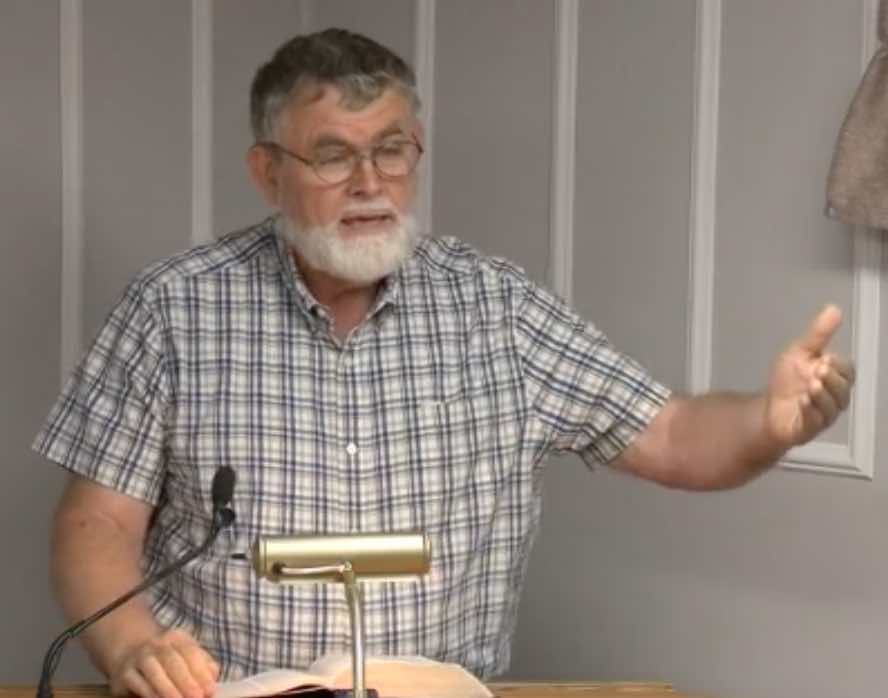
Mike McInnis is an elder at Grace Chapel in O'Brien Florida. He is also editor of the Grace Gazette.
Comments
Your comment has been submitted and is awaiting moderation. Once approved, it will appear on this page.
Be the first to comment!