Bootstrap
J.C. Ryle

Matthew 3

Matthew 3
J.C. Ryle October, 10 2019 Audio
0 Comments
You will find it helpful to READ the texts--as you LISTEN to the audios!
The TEXTS for the entire commentary can be bound here:
https://gracegems.org/Ryle/Matthew.htm

Sermon Transcript

Auto-generated transcript • May contain errors

100%
Section 5 of Expository Thoughts on the Gospel of St. Matthew by J. C. Ryle. Chapter 3, Verses 1 to 12. The Ministry of John the Baptist.

Matthew, Chapter 3, Verses 1 to 12. In those days came John the Baptist, preaching in the wilderness of Judea, and saying, Repent ye, for the kingdom of heaven is at hand. For this is he that was spoken of by the prophet Esaias, saying, The voice of one crying in the wilderness, Prepare ye the way of the Lord, make his paths straight.

And the same John had his raiment of camel's hair, and a leathern girdle about his loins, and his meat was locust and wild honey. Then went out to him Jerusalem, and all Judea, and all the region round about Jordan, and were baptized of him in the Jordan, confessing their sins.

But when he saw many of the Pharisees and Sadducees come to his baptism, he said unto them, O generation of vipers, who hath warned you to flee from the wrath to come? Bring forth, therefore, fruits meat for repentance, and think not to say within yourselves, We have Abraham as our father, for I say unto you that God is able of these stones to raise up children unto Abraham.

And now also the axe is laid unto the root of the trees. Therefore every tree which bringeth not forth good fruit is hewn down, and cast into the fire. I indeed baptize you with water unto repentance. But he that cometh after me is mightier than I, whose shoes I am not worthy to bear. He shall baptize you with the Holy Ghost, and with fire, whose fan is in his hand, and he will thoroughly purge his floor, and gather his wheat into the garner. But he will burn up the chaff with unquenchable fire.

These verses describe the ministry of John the Baptist, the forerunner of our Lord Jesus Christ. It is a ministry that deserves close attention. Few preachers ever produced such effects. There went out to him Jerusalem, and all Judea, and all the region round about Jordan. None ever received such praise from the great head of the Church. Jesus calls him a burning and shining light. The great Bishop of Soles himself declares that among them that are born of women there hath not arisen a greater than John the Baptist.

Let us then study the leading features of his ministry. John the Baptist spoke plainly about sin. He taught the absolute necessity of repentance before anyone can be saved. He preached that repentance must be proved by its fruits. He warned men not to rest on outward privileges or outward union with the Church. This is just the teaching that we all need. We are naturally dead, and blind, and asleep in spiritual things. We are ready to content ourselves with a mere formal religion, and to flatter ourselves that if we go to church we shall be saved. We need to be told that except we repent and are converted, we shall all perish.

John the Baptist spoke plainly about our Lord Jesus Christ. He taught that one far mightier than himself was coming among them. He was nothing more than a servant. The Coming One was the King. He himself could only baptize with water. The Coming One could baptize with the Holy Ghost. Take away sins, and would one day judge the world. This again is the very teaching that human nature requires. We need to be sent direct to Christ. We are all ready to stop short of this. We want to rest in our union with the Church, regular use of the sacraments, and diligent attendance on an established ministry. We ought to be told the absolute necessity of union with Christ Himself by faith. He is the appointed fountain of mercy, grace, life, and peace. We must each have personal dealings with Him about our souls. What do we know of the Lord Jesus? What have we got from Him? These are the questions on which our salvation hinges.

John the Baptist spoke plainly about the Holy Ghost. he preached that there was such a thing as the baptism of the Holy Ghost. He taught that it was the special office of the Lord Jesus to give it to men. This again is a teaching which we greatly require. We need to be told that forgiveness of sin is not the only thing necessary to salvation. There is another thing yet, and that is the baptizing of our hearts by the Holy Ghost. There must not only be the work of Christ for us, but the work of the Holy Ghost in us. There must not only be a title to heaven by the blood of Christ, but a preparedness for heaven wrought in us by the Spirit of Christ. Let us never rest till we know something by experience of the baptism of the Spirit. The baptism of water is a great privilege, but let us see to it that we also have the baptism of the Holy Ghost. John the Baptist spoke plainly about the awful danger of the impenitent and unbelieving. He told his hearers that there was a wrath to come. He preached of an unquenchable fire, in which the chaff would one day be burned. This again is a teaching which is deeply important. We need to be straightly warned that it is no light matter whether we repent or not. We need to be reminded that there is a hell as well as a heaven, and an everlasting punishment for the wicked as well as an everlasting life for the godly. We are fearfully apt to forget this. We talk of the love and mercy of God, and we do not remember sufficiently His justice and holiness. Let us be very careful on this point. It is no real kindness to keep back the terrors of the Lord. It is good for us all to be taught that it is possible to be lost forever, and that all unconverted people are hanging over the brink of the pit.

In the last place, John the Baptist spoke plainly about the safety of true believers. He taught that there was a garner for all who are Christ's wheat, and that they would be gathered together there in the day of His appearing. This again is a teaching which human nature greatly requires. The best of believers need much encouragement. They are yet in the body. They live in a wicked world. They are often tempted by the devil. They ought to be often reminded that Jesus will never leave them nor forsake them. He will guide them safely through this life and at length give them eternal glory. They shall be hid in the day of wrath. They shall be safe as Noah in the ark. Let these things sink down deeply into our hearts. We live in a day of much false teaching. Let us never forget the leading features of a faithful ministry. Happy would it have been for the Church of Christ if all its ministers had been more like John the Baptist.

Section 6 of Expository Thoughts on the Gospel of St. Matthew, by J. C. Ryle. Chapter 3, Verses 13-17

THE BAPTISM OF CHRIST

Matthew 3, Verses 13-17

Then cometh Jesus from Galilee to Jordan unto John to be baptized of him. But John forbade him, saying, I have need to be baptized of thee, and thou comest to me. And Jesus answering said unto him, Suffer it to be so now, for thus it becometh us to fulfill all righteousness." Then he suffered him. And Jesus, when he was baptized, went up straightway out of the water. And, lo, the heavens were opened unto him, and he saw the Spirit of God descending like a dove, and lighting upon him. And, lo, a voice from heaven saying, This is my beloved Son, in whom I am well pleased.

You have here the account of our Lord Jesus Christ's baptism. This was His first step, when He entered on His ministry. When the Jewish priests took up their office at the age of thirty, they were washed with water. When our great High Priest begins the great work He came into the world to accomplish, He is publicly baptized.

Let us learn from these verses to regard the sacrament of baptism with reverence. An ordinance of which the Lord Jesus Himself partook is not to be lightly esteemed. An ordinance to which the great Head of the Church submitted ought to be ever honorable in the eyes of professing Christians.

There are few subjects in religion on which greater mistakes have arisen than baptism. There are few which require so much fencing and guarding. Let us arm our minds with two general cautions. Let us beware, on the one hand, that we do not attach a superstitious importance to the water of baptism. We must not expect that water to act as a charm. We must not suppose that all baptized persons, as a matter of course, receive the grace of God in the moment that they are baptized. To say that all who come to baptism obtain like and equal benefit, and that it matters not a jot whether they come with faith and prayer, or in utter carelessness, to say such things appears to contradict the plainest lessons of Scripture.

let us beware, on the other hand, that we do not dishonor the sacrament of baptism. It is dishonored when it is thrust out of sight, and never publicly noticed in the congregation. A sacrament ordained by Christ Himself ought not to be treated in this way. The admission of every new member into the ranks of the visible Church, whether young or grown up, is an event which ought to excite a lively interest in a Christian assembly. It is an event that ought to call forth the fervent prayers of all praying people. The more deeply we are convinced that baptism and grace are not inseparably tied together, the more we ought to feel bound to join in prayer for a blessing whenever anyone is baptized.

The baptism of our Lord Jesus Christ was attended by circumstances of peculiar solemnity. Such a baptism will never be again, so long as the world stands. We are told of the presence of all three persons of the Blessed Trinity. God the Son, manifest in the flesh, is baptized. God the Spirit descends like a dove and lights upon Him. God the Father speaks from Heaven with a voice. In a word, we have the manifested presence of Father, Son, and Holy Ghost. Surely we may regard this as a public announcement, that the work of Christ was the result of the eternal counsels of all the three. It was the whole Trinity which at the beginning of creation said, Let us make man. It was the whole Trinity again which at the beginning of the gospel seemed to say, Let us save man.

We are told of a voice from heaven at our Lord's baptism. This was a circumstance of singular solemnity. We read of no voice from Heaven before this, except at the giving of the Law on Sinai. Both occasions were of peculiar importance. It therefore seemed good to our Father in Heaven to mark both with peculiar honor. At the introduction both of the Law and the Gospel, He Himself speaks. How striking and deeply instructive are the Father's words, This is my beloved Son, in whom I am well pleased. He declares, in these words, that Jesus is the divine Saviour sealed and appointed from all eternity to carry out the work of redemption. He proclaims that He accepts Him as the mediator between God and man. He seems to publish to the world that He is satisfied with Him as the propitiation, the substitute, the ransom payer for the lost family of Adam, and the head of a redeemed people. In him he sees his holy law magnified and made honorable. Through him he can be just, and yet the justifier of the ungodly. Romans 3, 26.

May we ponder these words well. They are full of rich food for thought. They are full of peace, joy, comfort and consolation for all who have fled for refuge to the Lord Jesus Christ, and committed their souls to Him for salvation.

Such may rejoice in the thought, that though in themselves sinful, yet in God's sight they are counted righteous. The Father regards them as members of His Beloved Son. He sees in them no spot, and for His Son's sake is well pleased.
J.C. Ryle
About J.C. Ryle
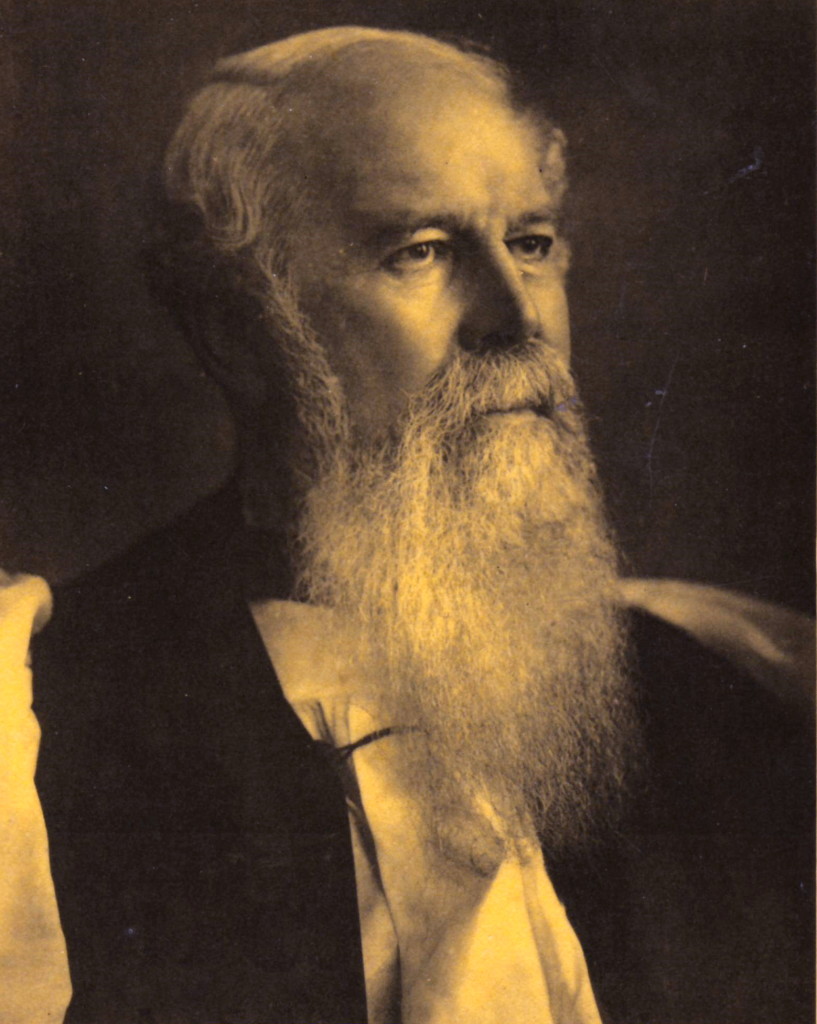
John Charles Ryle (10 May 1816 — 10 June 1900) was an English evangelical Anglican bishop. He was the first Anglican bishop of Liverpool.
Broadcaster:

Comments

0 / 2000 characters
Comments are moderated before appearing.

Be the first to comment!

Pristine Grace Research Assistant

Pristine Grace Research Assistant

Ask me about articles, sermons, or theology from our library. I can also help you navigate the site.