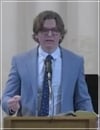
In Eric Van Beek's sermon titled "Christ Pointing Us To What Matters," he examines the theological significance of salvation through the narrow door as depicted in Luke 13:22-30, focusing primarily on verse 24. Van Beek argues that the central concern of the passage is not the number of those who will be saved but rather the urgency of personal salvation, emphasizing that each individual must strive to enter the narrow door, which symbolizes faith in Christ alone. He references Matthew 7:13-14 to illustrate the contrast between the narrow and the wide gates, asserting that many pursue a wide path of false salvation that relies on moralistic or ritualistic efforts. The practical significance of his message is a call for believers to introspectively question their own salvation, moving away from discussions about others' spiritual states, and to recognize that true salvation is found solely in Christ, devoid of personal merits or works.
Key Quotes
“The issue of the gospel is not how many will be saved. Rather, our concern should be, am I among that number?”
“Make every effort to enter the narrow door because many, I tell you, will try to enter and will not be able to.”
“When you are nothing but a sinner in need of Christ, Christ will be all you need.”
“God grant us all the grace to enter by the narrow gate.”
The Bible emphasizes the importance of making every effort to enter through the narrow door, as many will try but will not be able to.
In Luke 13:24, Christ instructs us to 'make every effort to enter through the narrow door,' indicating that salvation is a serious endeavor. This narrow door symbolizes the exclusive way to eternal life, which is through faith in Christ alone. Many may seek to enter, relying on their own merits, but without a true understanding of their sinfulness and need for Christ, they will find themselves unable to enter. The focus should be not on the number of those who will be saved but rather on our own personal assurance of being among them.
Luke 13:24, Matthew 7:13-14
Christians must strive for salvation by recognizing their sinfulness and resting in Christ’s finished work, as this is vital for entering eternal life.
Striving for salvation is crucial as it involves recognizing our complete dependence on Christ. While we cannot earn our salvation through works, we are called to make an effort to deny our self-righteousness and trust solely in Jesus. Hebrews 4:11 encourages us to 'labor to enter that rest,' emphasizing the struggle against our fleshly nature to attain true peace and salvation in Him. It is not about performing good deeds but understanding that we come as needy sinners, solely relying on Christ's sacrifice.
Hebrews 4:11, John 14:6
The Bible asserts that Christ is the only way to salvation, as He alone embodies the truth and the life.
The exclusivity of Christ as the only way to salvation is clearly articulated in John 14:6, where Jesus declares, 'I am the way and the truth and the life. No one comes to the Father except through me.' This statement underscores that all necessary provisions for salvation are found in Jesus Christ alone. The narrow gate through which we must pass is not wide enough to accommodate our works, moral deeds, or any attempts to justify ourselves; it is only through a recognition of our sinfulness and complete faith in Christ that we can be saved.
John 14:6, Luke 13:24
Making every effort to enter the narrow door means striving against our own self-righteousness and resting in Christ’s work for salvation.
Making every effort entails a personal, inward struggle to lay aside self-righteousness and trust fully in Christ. It means recognizing the natural tendency to rely on our works and the need to turn away from them. The effort is about submitting to God's way of salvation—admitting that we cannot arrive at perfection on our own and believe in Christ's finished work. This is a challenging venture against our flesh and is essential for experiencing true salvation and entering into eternal life.
Luke 13:24, Hebrews 4:11
Many struggle to enter through the narrow door because they attempt to bring their works and self-righteousness as credentials.
The struggle many face in entering through the narrow door stems from their reliance on personal achievements and righteousness. Jesus warns that many will try to enter but will not be able to, largely because they cannot fit through with their own merits, ceremonies, or moral standing. The gate is meant only for those who approach as sinners, without any pretense of righteousness. This underscores a needed humility where we recognize that it is solely through grace received by faith in Christ that one can find true acceptance with God.
Luke 13:24, Matthew 7:13-14
Comments
Your comment has been submitted and is awaiting moderation. Once approved, it will appear on this page.
Be the first to comment!
