Bootstrap
J.C. Ryle

John 19:17-27

John 19:17-27
J.C. Ryle November, 20 2022 Audio
0 Comments
You will find it helpful to READ the texts--as you LISTEN to the audios!
The TEXTS for the entire commentary can be bound here:
https://www.gracegems.org/Ryle/John.htm

Sermon Transcript

Auto-generated transcript • May contain errors

100%
Section 28 of Expository Thoughts on the Gospel of St. John, Volume 3 by J. C. Ryle. CHAPTER XIX. And he bearing his cross went forth into a place called the Place of a Skull, which is called in the Hebrew Golgotha, where they crucified him and two other with him, on either side one and Jesus in the midst. And Pilate wrote a title and put it on the cross, and the writing was, Jesus of Nazareth, the King of the Jews. This title then read, Many of the Jews, for the place where Jesus was crucified was nigh to the city, and it was written in Hebrew, and Greek, and Latin. Then said the chief priests of the Jews to Pilate, Write not, The King of the Jews, but that he said, I am the King of the Jews. Pilate answered, What I have written, I have written.

Then the soldiers, when they had crucified Jesus, took his garments, and made four parts to every soldier apart, and also his coat. Now the coat was without seam, woven from the top throughout. They said, therefore, among themselves, Let us not rend it, but cast lots for it, whose it shall be, that the Scripture might be fulfilled, which saith, They parted my raiments among them, and for my vesture they did cast lots. These things, therefore, the soldiers did.

there stood by the cross of Jesus his mother, and his mother's sister, Mary the wife of Cleophas, and Mary Magdalene. When Jesus therefore saw his mother, and the disciples standing by, whom he loved, he saith unto his mother, Woman, behold thy son. Then saith he to the disciple, Behold thy mother. And from that hour that disciple took her unto his own home.

He that can read a passage like this without a deep sense of man's debt to Christ must have a very cold or a very thoughtless heart. Great must be the love of the Lord Jesus to sinners when He could voluntarily endorse such sufferings for their salvation. Great must be the sinfulness of sin when such an amount of vicarious suffering was needed in order to provide redemption.

We should observe, first, in this passage, how our Lord had to bear His cross when He went forth from the city to Golgotha. We need not doubt that there was a deep meaning in all this circumstance. For one thing, it was part of that depth of humiliation to which our Lord submitted as our substitute. One portion of the punishment imposed on the vilest criminals was that they should carry their own cross when they went to execution, and this portion was laid upon our Lord. In the fullest sense He was reckoned a sinner and counted a curse for our sakes. For another thing, it was a fulfillment of the great type of the sin offering of the Mosaic law. It is written that the bullock for the sin offering and the goat for the sin offering, whose blood was brought in to make atonement in the holy place, shall one carry forth without the camp. Leviticus chapter 16, verse 27. Little did the blinded Jews imagine, when they madly hounded on the Romans to crucify Jesus outside the gates, that they were unconsciously perfecting the mightiest sin offering that was ever seen. It is written, Jesus, that he might sanctify the people with his own blood, suffered without the gate. Hebrews chapter 13 verse 12.

The practical lesson which all true Christians should gather from the fact before us is one that should be kept in continual remembrance. Like our Master, we must be content to go forth without the camp, bearing his reproach. We must come out from the world and be separate, and be willing, if need be, to stand alone. Like our Master, we must be willing to take up our cross daily, and to be persecuted both for our doctrine and our practice. Well would it be for the Church if there was more of the true cross to be seen among Christians. To wear material crosses as an ornament, to place material crosses on churches and tombs, all this is cheap and easy work and entails no trouble. But to have Christ's cross in our hearts, to carry Christ's cross in our daily walk, To know the fellowship of His sufferings, to be made conformable to His death, to have crucified affections, and to live crucified lives—all this needs self-denial. And Christians of this stamp are few and far between.

Yet this, we may be sure, is the only cross-bearing and cross-carrying that does good in the world. The times require less of the cross outwardly and more of the cross within.

We should observe, secondly, in this passage, how our Lord was crucified as a king. The title placed over our Lord's head made this plain and unmistakable. The reader of Greek or Latin or Hebrew could not fail to see that he who hung on the central cross of the three on Golgotha had a royal title over his head. The overruling hand of God so ordered matters that the strong will of Pilate overrode for once the wishes of the malicious Jews. In spite of the chief priests, our Lord was crucified as the King of the Jews.

It was meet and right that so it should be. Even before our Lord was born, the angel Gabriel declared to the Virgin Mary, the Lord God shall give unto him the throne of his father David, and he shall reign over the house of Jacob forever, and of his kingdom there shall be no end. Luke chapter 1 verses 32 and 33. Almost as soon as he was born, there came wise men from the east, saying, Where is he that is born King of the Jews? Matthew 2.2. The very week before the crucifixion, the multitude who accompanied our Lord at His triumphal entry into Jerusalem had cried, Blessed is the King of Israel that cometh in the name of the Lord. John 12.13. The current belief of all godly Jews was, that when Messiah, the son of David came, he would come as a king.

A kingdom of heaven and a kingdom of God was continually proclaimed by our Lord throughout his ministry. A king indeed he was, as he told Pilate, of a kingdom utterly unlike the kingdoms of this world, but for all that a true king of a true kingdom, and a ruler of true subjects. As such he was born. As such he lived. as such he was crucified, and as such he will come again, and reign over the whole earth, King of kings and Lord of lords.

Let us take care that we ourselves know Christ as our King, and that His kingdom is set up within our hearts. They only will find Him as their Saviour at the last day, who have obeyed Him as King in this world. Let us cheerfully pay Him that tribute of faith and love and obedience, which He prizes far above gold. Above all, let us never be afraid to own ourselves his faithful subjects, soldiers, servants, and followers, however much he may be despised by the world.

A day will soon come when the despised Nazarene who hung on the cross shall take to himself his great power and reign, and put down every enemy under his feet. the kingdoms of this world, as Daniel foretold, shall be swept aside and become the kingdom of our God and of his Christ. And at last every knee shall bow to him, and every tongue confess that Jesus Christ is Lord. We should observe, lastly, in these verses, how tenderly our Lord took thought for Mary, his mother. We are told that even in the awful agonies of body and mind which our Lord endured, he did not forget her of whom he was born. He mercifully remembered her desolate condition, and the crushing effect of the sorrowful sight before her. He knew that, holy as she was, she was only a woman, and that, as a woman, she must deeply feel the death of such a son. He therefore commended her to the protection of his best-loved and best-loving disciple, in brief and touching words.

Woman, he said, behold thy son. Then saith he to the disciple, behold thy mother. and from that hour that disciple took her unto his own home.

We surely need no stronger proof than we have here that Mary, the mother of Jesus, was never meant to be honored as divine, or to be prayed to, worshipped, and trusted in, as the friend and patroness of sinners. Common sense points out that she who needed the care and protection of another was never likely to help men and women to heaven, or to be in any sense a mediator between God and man. It is not too much to say, however painful the assertion, that of all the inventions of the Church of Rome, there never was one more utterly devoid of its foundation, both in Scripture and reason, than the doctrine of Mary-worship.

Let us turn from points of controversy to a subject of far more practical importance. Let us take comfort in the thought that we have in Jesus, a savior of matchless tenderness, matchless sympathy, matchless consideration for the condition of his believing people. Let us never forget his words, whosoever shall do the will of God, the same is my brother and my sister and mother. Mark chapter 3 verse 35. The heart that even on the cross felt for Mary is a heart that never changes. Jesus never forgets any that love him, and even in their worst estate remembers their need. No wonder that Peter says, Casting all your care upon him, for he careth for you. 1 Peter 5, verse 7.

Notes, John 19, verses 17 to 27.

Verse 17, And he bearing his cross, It was the Roman custom to compel criminals sentenced to crucifixion to carry their own cross. Our Lord was thus treated like the vilest felon. Furcifer was the Latin name of ignominy and contempt given to the worst criminals. It means, literally, cross-bearer. Besser observes that our Lord, when a workman in the carpenter's shop at Nazareth, had willingly carried pieces of timber in the service of his foster father. Here, with no less cheerfulness, he bears to Golgotha the timber of the cross, in order to raise the altar on which he is to be sacrificed, and to do the will of his Father in heaven.

Whether the cross that our Lord bore was a straight piece of timber, with another transverse piece fixed across it for the hands of the criminal to be nailed to, or whether it was a tree with two forked arms, admits perhaps of some little doubt. The almost universal tradition of the churches is that it was the former, viz. a cross made of two pieces. Yet it is worth remembering that it was very common to crucify on a tree, such as I have described, that the Latin word for cross-bearer means literally forked tree-bearer, and that our Bible translators have four times spoken of the wood on which our Lord was crucified as the tree. Acts chapter 5 verse 30, chapter 10 verse 39, chapter 13 verse 29, and 1 Peter chapter 2 verse 24. The matter, therefore, is not quite so clear as some may think, though of course it is one of no consequence.

The cross of two pieces at right angles is certainly more picturesque than a common tree shaped like the letter Y, and the habitual use of the cross in Christian art, and the general tradition of ecclesiastical history, have combined to make most people regard the question as a settled one. Yet the undeniable use of forked trees in crucifying criminals, and the equally undeniable difficulty of carrying a cross of two transverse pieces compared with a forked tree, are points that really ought not to be overlooked. The matter, after all, is one of pure conjecture. But, to say the least, it is quite a disputable point whether the cross with which Christendom is so familiar, on the gable ends of churches on tombs, in painted windows, in crucifixes, or in the simple ornamental forms which ladies are so fond of wearing. The cross, I say, of two transverse pieces at right angles, is really and truly the kind of cross on which Christ was crucified. there is no proof positive that the whole of Christendom is not mistaken. Of course, if the cross itself had been preserved and found, it would settle the dispute. But there is not the slightest reason to suppose that it was preserved, or treated with any respect, either by Jews, Romans, or disciples. The famous story of the discovery or invention of the cross, by the Empress Helena, in 326 A.D., is a mere apocryphal legend, invented by man. and deserves no more attention than the many pretended pieces of true cross which are exhibited in Roman churches as sacred relics. Ambrose says, quaintly enough, that the form of the cross is that of a sword with a point downward, above is the hilt toward heaven, as if in the hand of God, below is the point toward earth, as if thrust through the head of the old serpent, the devil. Only one thing is very certain. Whatever the shape of the cross on which Jesus was crucified, it could not have been the huge, tall, heavy thing which painters and sculptors have continually represented it to be. To suppose that any man could carry such an enormous weight of timber, as the cross is made to be, in Rubens' famous picture of the Descent from the Cross, is preposterous and absurd. A cross was manifestly not a larger thing than could be lifted and borne on the shoulders of one person. Some get over the difficulty by maintaining the theory that the transverse piece was the only part of the cross which the criminal carried, but there is no sufficient evidence that this was the case. It is noteworthy that John is the only evangelist who says that our Lord bore his own cross. Matthew, Mark, and Luke all say that Simon the Cyrenian was compelled to bear it. The explanation is probably this. Our Lord bore the cross for a short part of the way from the judgment seat to Golgotha. Weakness and physical exhaustion, after all the mental and bodily suffering of the last night, rendered it impossible for Him to carry it all the way. Just at the moment when his strength failed, perhaps at the city gate, the soldier saw Simon coming into the city, and pressed him into the service. As on other occasions John records a fact which the other evangelists for wise reasons passed over. It is interesting to remember that the circumstance is one which John must have seen in all probability with his own eyes. That our blessed Lord, who had a body like our own, and not a body of superhuman vigour, should have been unable to carry the cross more than a little way, need not surprise us at all, if we consider all that He had gone through to try His physical strength, and tax His nervous system to the utmost, in the eighteen hours preceding His crucifixion. It is hardly necessary to remark that the type of Isaac bearing the wood for the sacrifice on Moriah, in which he himself was to be the victim, was here fulfilled by our Lord. It is, moreover, a curious circumstance, unmentioned by Bishop Pearson, that the Jewish commentator on Genesis 22.6 speaks of Isaac carrying the wood for the burnt offering as a man carries his cross upon his shoulders. Went forth. That expression shows clearly that our Lord went out of the city to be crucified. He was condemned in the open air, and went forth, cannot mean out of Pilate's house, but went outside of Jerusalem, without the gates. Trifling as this incident may seem to a careless reader, it is a striking fulfillment of one of the great types of the Mosaic law. The sin offering on the great day of atonement was to be carried forth without the camp. Leviticus chapter 16 verse 27. Our Lord came to be the true sin offering, to give His soul an offering for our sins. Therefore it was divinely overruled of God that, in order to fulfill the type perfectly, He should suffer outside the city. See also Leviticus chapter 6 verses 12 to 21. St. Paul specifically refers to this when he tells the Hebrew Christians, who were familiar with the law of Moses, that Jesus suffered without the gate. Hebrews chapter 13 verse 12. The minutest details of our Lord's passion have a deep meaning. Into a place, skull, Golgotha. The precise position of this place is not known, certainly, and can only be conjectured. We only know, from verse 20, that it was nigh to the city, that it was outside the walls of Jerusalem, at the time of our Lord's crucifixion, and that it was near some public road, as there is mentioned in one gospel of them that passed by. Matthew, chapter 27, verse 39. So many changes have taken place during the long period of 1800 years in the boundary walls and the soil of Jerusalem that no wise man will speak positively as to the exact whereabouts of Golgotha at this day. Though outside the walls eighteen hundred years ago, it is far from unlikely that it is within the walls at this time. A. Some maintain, as most probable, that Golgotha was a place between the then-existing wall of Jerusalem and the descent into the valley of the Kidron, on the east side of the city, near the road leading to Bethany. In this case the cross must have been in full view of any one standing on the tower of Antonia in the Temple Courts, on the Mount of Olives, or upon the eastern wall of the city. If this is correct, the crucifixion might have been seen by hundreds of thousands of people at once with perfect ease, and from the sufferer being lifted up, as it were, in the air, must have been an event of extraordinary publicity. According to the advocates of this theory, the traditional site now assigned to the Holy Sepulchre is the true one. b. Others, however, who have carefully examined the topography of Jerusalem, are extremely likely to be wise and impartial judges, are decidedly of opinion that Golgotha was on the north side of Jerusalem, near the Damascus gate, and they repudiate altogether the site commonly assigned to the Holy Sepulchre at the present time. An old and valued friend, who has walked repeatedly over this debatable land, says, I think the crucifixion took place on the north side of the city, near the present Damascus Gate, on a platform of rock just above the valley which runs on in endless tombs nearly two miles. Beneath this platform is a garden of olives still, full of excavations, and one of these, I think, was a sepulchre. C. Others, and among them another friend, who has travelled much in Palestine and published the results of his travels, inclined to think that Golgotha was on the west side of Jerusalem near the Jaffa Gate. The friend I refer to says in a letter to me on this subject, When I was first in Jerusalem in 1857, I visited some extraordinary fissures and cracks in the rocks west of the city, reminding me of the expression, the rocks rent. Matthew chapter 27 verse 51. These fissures are all now filled up. Much, he adds, depends on the question whether Pilate resided in the tower of Antonia, and had his judgment hall there, or in the tower of Hippicus. This, however, we have no means of ascertaining. In the face of such conflicting opinions, I dare not speak positively, and I must leave my readers to judge for themselves. The question is one about which no one, it is clear, has any right to be heard, unless he has actually seen Jerusalem. Why the place was called the place of a skull we are not told and are left entirely to conjecture. A. Some think, as Galter, Bullinger, Muscullus, Gerhard, Burgon, Alfred, Besser, and others, that the verse points to the bones, skeletons, and skulls of executed criminals which were lying about on Golgotha as the commonplace of execution. This theory, however, is open to grave objection, that it is most unlikely that dead men's bones would be left lying above ground so near the city, when, According to the Mosaic law, they made any Jew unclean who touched them. The Pharisees, with their excessive scrupulosity about externals, were not likely to tolerate such a source of defilement close to the holy city. Moreover, John expressly says that in the place where Jesus was crucified there was a garden. John chapter 19 verse 41. This does not look like a place where dead men's bones and skulls of criminals will be left lying around. The very mention of this garden would suggest the idea that the place was not ordinarily used for execution, and that the Pharisees chose it only for its singular publicity. If it was on the East side, we can well believe that they felt a diabolical pleasure in tormenting our Lord to the last, by making Him die with the Temple and the Mount of Olives and His favorite Gethsemane before His eyes.

Some think, as Lamp, Ellicott, and others, that the name Place of a Skull arose from the shape of the small rising ground, like a skull on which the cross was fixed. that such small elevations of limestone rock are to be found in that vicinity is asserted by some travellers. To me there seems more probability in this theory than in the other. The name Calvary, we should remember, is never used in the Greek, and the marginal reading in Luke 23.33 ought certainly to be in the text. One thing alone is very certain. There is not the slightest authority for the common idea that the place where our Lord was crucified was a hill or mountain. The common expression in hymns and religious poetry, Mount Calvary, is utterly incorrect and unwarrantable, and the favorite antithesis or comparison between Mount Sinai and Mount Calvary is so completely destitute of any scriptural basis that it is almost profane. Anything more unlike, as a matter of fact, than Sinai and Golgotha cannot be conceived.

Origen, Cyprian, Epiphanius, Augustine, Jerome, and Theophilact all mention in old tradition that Golgotha was the place where the first Adam, our forefather, was buried, and that the second Adam was buried near the first. This, of course, is a ridiculous lying fable, as Noah's flood must have swept away all certainty about Adam's grave. Verse 18, where they crucified him. This famous mode of execution is so well known to everyone that little need to be said about it. The common mode of inflicting it, in all probability, was to strip the criminal, to lay him on the cross on his back, to nail his hands to the two extremities of the cross-piece or fork of the cross, to nail his feet to the upright piece or principal stem of the cross, then to raise the cross on end and drop it into a hole prepared for it, and then to leave the sufferer to a lingering and painful death. It was a death which combined the maximum of pain with the least immediate destruction of life. The agony of having nails driven through parts so full of nerves and sinews as the hands and feet must have been intense. Yet wounds of the hands and feet are not mortal and do not injure any great leading blood vessel. Hence, a crucified person, even in an eastern climate exposed to the sun, might live two or three days, enduring extreme pain, without being relieved by death, if he was naturally a very strong man and in vigorous health. This is what we must remember our blessed Lord went through when we read, they crucified him. To a sensitive, delicate-minded person, it is hard to imagine any capital punishment more distressing. This is what Jesus endured willingly for us sinners.

Hanging, as it were, between earth and heaven, he exactly filled the type of the brazen serpent which Moses lifted up in the wilderness. John chapter 3 verse 14. Whether the person crucified was bound to the cross with ropes, to prevent the possibility of his breaking off from the nails and convulsive struggling, whether he was stripped completely naked or had a cloth round his loins, whether each foot had a separate nail or one nail was driven through both feet, are disputed points which we have no means of settling. Some think, following Irenaeus, Tertullian, and Justin Martyr, that there was a kind of seat or projection, in the middle of the stem of the cross, to bear up the weight of the body, and also a place for the feet to rest on. Jeremy Taylor thinks, in support of this view, that the body of a crucified person could not rest only on the four wounds of hands and feet. Bishop Pearson also quotes a passage from Seneca which seems to favor the idea. As to the nails, Nowanus and Gregory Nazanzen says there were only three and that one was driven through both feet at once. Cyprian says there were four. But these are matters about which we really know nothing, and it is useless to guess and speculate about them. Of one thing, however, we may be very sure. The feet of the crucified person were much nearer the ground than is commonly supposed, and very likely not more than a foot or two from the earth. In this, as in other points, most pictures of the crucifixion are grossly incorrect, and the cross is made out to be a piece of timber so long and so thick that no one mortal man could have ever carried it.

Concerning the precise amount of physical suffering and the precise effect on the human body in a crucifixion, the following medical account by a German physician named Richter, quoted in Smith's Dictionary of the Bible, can hardly fail to interest a Bible reader.

He says,
1. The unnatural position and violent tension of the body caused a painful sensation from the least motion.
2. The nails being driven through parts of the hands and feet which are full of nerves and tendons, and yet, at a distance from the heart, created the most exquisite anguish.
3. The exposure of so many wounds and lacerations brought on inflammation, which tended to become gangrene, and every movement increased the poignancy of suffering.
4. In the distended parts of the body more blood flowed through the arteries than could be carried back to the veins, and hence too much blood found its way, from the aorta, into the head and stomach, and the blood vessels of the head became pressed and swollen. The general obstruction of circulation caused an internal excitement, exertion, and anxiety more intolerable than death itself.
5. There was an inexpressible misery of gradually increasing and lingering anguish.
6. To all this we may add burning and raging thirst.

Smith's Dictionary of the Bible, Article of Crucifixion.

On the whole subject of the cross and the sufferings connected with crucifixion, Lipsias de Cruce, published in 1595, is a most exhaustive book.

When we remember, besides all this, that our Lord's head was crowned with thorns, his back torn with savage scourging, and his whole system weighed down by the mental and bodily agony of the sleepless night following the Lord's Supper, we may have some faint idea of the intensity of his sufferings.

When we read, they crucified, we are left to conjecture who it can refer to. It cannot be the Jews, because they could only stand by and superintend at the most, as the Roman soldiers would certainly not let the punishment be inflicted by any other hands than their own. It must either be the four soldiers who were the executioners, or else it must be interpreted generally after the manner of other places for, he was crucified. Thus in John chapter 16 verse 2, they shall put you out of the synagogues. In that sentence they cannot refer to any person in particular. The simplest plan is to refer it generally to the whole party, Jews and Gentiles together.

and two others with him, etc.

We know from the other Gospels that these other two were malefactors and thieves. The object of crucifying our Lord between them is plain. It was intended as a last indignity and injury. It was a public declaration that he was counted no better than the vilest criminals.

Little as our Lord's enemies meant it, this very crucifixion between two thieves did two great things. One was that it precisely fulfilled Isaiah's prophecy about Messiah—he was numbered with the transgressors—Isaiah 53.12. The other was that it gave our Lord the opportunity of working one more mighty miracle, even in His last hours—the miracle of converting the penitent thief, forgiving his sins, and opening to him Paradise.

If his enemies had been content to crucify him alone, this last trophy could not have been won, and our Lord's power over sin and the devil would not have been exhibited. So easy is it for God to bring good out of evil, and to make the malice of his enemies work round to his praise.

Augustine remarks that three very different persons hung together on the three crosses on Golgotha. One was the saviour of sinners, one was a sinner about to be saved, one was a sinner about to be damned. On Psalm 34. Cyril sees in the two malefactors a type of the Jewish and Gentile churches, the one rejected, impenitent and lost, the other believing at the eleventh hour and saved.

Many pious commentators remark that even on the cross our Lord gave an emblem of His kingly power. On His right hand was a saved soul whom He admits into His kingdom, on His left hand a soul whom He leaves to reap the fruit of His own ways. There was right and left on the cross, even as there will be right and left, saved and unsaved, when He sits on the judgment seat, wearing the crown at the last day.

It only remains to add that the cruel punishment of crucifixion was formally abolished by the Emperor Constantine towards the end of his reign. It is an awful historical fact that when Jerusalem was taken by Titus, he crucified so many Jews around the city that Josephus says that space and room failed for crosses, and crosses could not be found sufficient in number for bodies.

Raeland Well remarks, they who had nothing but crucify in their mouths were therewith paid home in their bodies.

and Pilate wrote a title, Cross. To fix a board with an inscription over the head of the person crucified appears to have been a well-known custom, and is mentioned as such by classical writers. Some say it was a board covered with white gypsum, with letters of black, and others say that the letters were red. Pilate therefore did nothing unusual.

In our Lord's case it served two ends, whether Pilate meant them or not. For one thing, it proclaimed to all passers-by, all who saw the crucifixion, that Jesus did really suffer, that he was not at the last moment released, and another punished in his stead, and that he was not taken away by miraculous interference from his enemy's hands. For another thing, it drew the attention of all witnesses and passers-by to our Lord and made it quite certain on which of the three crosses He hung.

Without this, a person looking at three naked figures hanging on the crosses from a little distance off might well have doubted which of the three was Jesus. The title made it plain. That our Lord was regarded as no common everyday criminal and that it was thought right to call special attention to Him is evident from this title being put on His cross.

Jesus, Nazareth, King, Jews Pilate's reasons for choosing to place this description of our Lord over his cross we are left to conjecture. My own decided opinion is that he worded the title as he did in anger and vexation and with an intention to annoy and insult the Jews. He publicly held up to scorn their king as a poor criminal from a mean village in Galilee, a fitting king for such people.

Whatever his motive may have been, it was curiously overruled by God that even on the cross our Lord should be styled a king. He came to be a king, and as king he lived and suffered and died, though not acknowledged and honored by his subjects. Nazarene identified our Lord as the well-known teacher from Galilee, who for three years had stirred the Jewish mind. King identified him as the person accused by the chief priests for claiming a kingdom, and formally rejected by them on the plea that they had no king but Caesar.

It was a very full and significant title. A careful reading of the Gospels will not fail to observe that each Gospel writer gives this title in a slightly different form, and that there are, in fact, four versions of it. The question naturally arises, which is correct? The versions do not at all contradict one another, but that of Mark, the king of the Jews, is much shorter than that of John. No two, in a word, are exactly alike.

In reply, it is fair to remind the reader that the inscription was written in three languages, and that it is far from unlikely that it was in one form in one language and in another form in another. The one common point in all the four verses is, the King of the Jews, and this was probably the only point that Mark, in his brief and condensed history, was taught to record. John gives the whole inscription because he alone narrates the dispute between the priests and Pilate about it.

If I may venture a conjecture, I should guess that Mark gives the Latin inscription, Luke the Greek and Matthew and John the Hebrew one. But why it seemed good to the Holy Ghost that Matthew should omit the expression of Nazareth, which John mentions, I do not pretend to say. It is precisely one of those things in which it is wisest to confess our ignorance and to be willing to wait for more light.

St. John alone records that Pilate wrote and put on the cross this title. We are not obliged to suppose that he did it both with his own hands. The writing was almost certainly his own act. The putting the title on the cross he probably left to the soldiers. The common pictures of the crucifixion, showing a kind of scroll or parchment over our Lord's head on the cross, are most probably in this, as in other details, most incorrect representations of the real facts.

Moreover, most painters seem to forget that it was written three times over, being in three languages.

Verse 20. The title, then read many, etc. This seems to be one of John's parenthetical comments. It also reads like the report of an eyewitness. And this we know John was. He stood by and saw all that happened. It is as though he said, I can testify that many of the Jews saw and read this title, some as they passed along the road which ran by, some from the walls of the city, for the place was near the walls.

It was an inscription, moreover, so contrived that hardly anyone in Jerusalem could fail to understand it, for it was written, in the three languages most likely to be known, in Hebrew, Greek, and Latin. It is almost needless to say that the title was in Hebrew, because every Jew would know it, the oldest language in the world, and the language of the Old Testament.

In Greek, because this was the language most known in all Eastern countries, and the language of all literary and educated people. In Latin, because this was the language of the Romans, the ruling nation in the world. The Roman soldiers would all understand the Latin, the Greek proselytites and Hellenistic Jews would all understand the Greek, and the pure Jews from Galilee and Judea and every part of the earth, assembled for the Passover, would all understand the Hebrew.

All would go away to spread the tidings that one Jesus, the King of the Jews, had been put to death by crucifixion at the Passover feast.

Henry remarks, In the Hebrew, the oracles of God were recorded, in Greek, the learning of the philosophers, and in Latin, the laws of the empire. In each of these three languages Christ is proclaimed King, in whom are hid all the treasures of revelation, wisdom, and power. To this very day it is certain that no three languages can be more useful for a Christian minister to know, if he would be familiar with his Bible, than Hebrew, Greek, and Latin.

The last day alone, perhaps, will disclose the effect this title had on those who read it. When the priests and their companions saw it, they mocked and scoffed. King, indeed! Let Christ, the King of Israel, descend from the cross, and we will believe!

But there was one man who saw the title probably with very different eyes. The penitent thief, perhaps, grasped at the word King and believed. Who can tell that this was not the root of his cry, Lord, remember me, when thou comest into thy kingdom. Luke 23, verse 42. Perhaps Pilate's title helped to save a soul.

Brentius remarks, that when we think of the cross of Christ, and the title on it, which so many read, we should remember that there was another handwriting nailed to that cross spiritually, which no mortal could read. Jesus Christ, by his vicarious death for us, blotted out the handwriting of ordinances that were against us, which was contrary to us, and took it out of the way, nailing it to his cross.

Then said the chief priests, etc. These verses bring out the feeling which the sight of Pilate's title excited in the minds of the chief priests. They were annoyed and angry. They did not like the idea of this crucified criminal being publicly declared the King of the Jews. They detected the latent scorn and irony which guided Pilate's hands, and lay at the bottom of his mind. They did not like so public an announcement that they had crucified their own king, and wanted no king but Caesar. They were vexed at the implied reflection on themselves.

Besides this, they were probably uncomfortable in conscience, hardened and wicked as they were, they had, many of them, we may be sure, a secret conviction which they vainly tried to keep down, that they were doing a wrong thing, and a thing which by and by they would find it hard to defend either to themselves or others. Hence they tried to get Pilate to alter the title, and make it appear that our lord was only a pretended king, an imposter who said that he was a king. This, they doubtless thought, would shift some of the guilt off their shoulders, and make it appear that our lord was crucified for usurping a title to which he was legally proved to have no claim.

When and where the chief priests said this to Pilate does not appear. It must either have been when the whole party was leaving the judgment seat for Golgotha, or after our lord was nailed to the tree while the soldiers were nailing him. Looking at St. John's account, one may fancy that the centurion sent word to Pilate that the prisoner was being nailed to the cross and asked for a title to put over his head, before the cross was reared. If we do not suppose this, we must believe that Pilate actually accompanied the party outside the walls and was only at a little distance off during the last horrible preparations. In that case, he might easily write a title, and the priest might easily be standing by. The difficulty is to understand where the parties could be when the priest said, write not, and it is one which must be left unsettled. It seems, however, certain that once put over our Lord's head, the title was not expected to be taken down, and the request was not to alter it after being put up, but to write a different title before it was put up.

Bengal observes that this is the only place in St. John's Gospel where the chief priests are called the chief priests of the Jews. He thinks it is intended to mark emphatically the bitter hatred with which the priests of the Jews regarded the king of the Jews. We may well believe that even the wickedest men at their worst are more sore and uncomfortable inwardly than they would appear outwardly. This it was that probably lay at the bottom of the chief priest's remonstrance about the title. Herod's cry, It is John the Baptist, after John was dead, is another case in point.

Verse 22 Pilot answered, I have written, The hard, haughty, imperious character of the wicked Roman governor comes out forcibly in these words. They show his contempt for the Jews. Trouble me not about the title. I have written it, and I shall not alter it to please you. They suggest the idea that he was willing enough to be revenged on them for their obstinate refusal to meet his wishes and consent to our Lord's release. He was glad to hold them up to scorn and contempt as a people who crucified their own king.

It is likely enough that between his wife and his own conscience and the chief priest, the Roman governor was vexed, worried and irritated, and savagely resolved not to gratify the Jews any further in any matter. He had gone as far as he chose in allowing them to murder an innocent and just person. He would not go an inch further. He now made a stand, and showed that he could be firm and unyielding and unbending when he liked. It is no uncommon thing to see a wicked man, when he has given way to the devil and trampled on his conscience in one direction, trying to make up for it by being firm in another.

Calvin observes that Pilate, by publishing in three languages Christ's title, was, by a secret guidance, made the herald of the gospel. He contrasts his conduct with that of the papists who prohibit the reading of the gospel and the scriptures by the common people. Galter says much the same. Bollinger remarks that Pilate acted like Caiaphas when he said, It is expedient that one die for the people, not knowing what he said. Just so Pilate little knew what testimony he was bearing to Christ's kingly office. Lee quotes a saying of Augustine, if a man like Pilate can say, What I have written I have written, and will not alter, can we think that God doth write any in his book, and blot it out again?

The soldiers, having now finished their bloody work, having nailed our Lord to the cross, put the title over His head, and reared the cross on end, proceeded to do what they probably always did, to divide the clothes of the crucified criminal among themselves. In most countries the clothes of a person put to death by the law are the prerequisite of the executioner. So it was with our Lord's clothes. They had most likely first stripped our Lord naked, before nailing His hands and feet to and had laid his clothes on one side till they had finished their work. They now turned to the clothes and, as they had done many a time on such occasions, proceeded to divide them. All four evangelists particularly mention this, and evidently call our special attention to it. The division into four portions shows clearly that there were four soldiers employed, besides a centurion, in the work of crucifixion. Many commentators see in them emblems of the four quarters of the Gentile world. This, however, seems to me fanciful. A quaternion, a small party of four, was a common division of soldiers in those days, just as a file of men is among ourselves. What the four portions of garments were we are left to conjecture. Hengstenberg thinks they consisted of the covering of the head, the girdle, the shoes, and the undergarment fitting the body. Matthew's report of the Sermon on the Mount contains a clear distinction between a coat and a cloak. Matthew chapter 5 verse 40. For these four portions, the soldiers probably cast lots in order that each one might have his part decided and to prevent wrangling about the unequal value of the portions. Others think that the language of St. John about the coat, which was not rent, is strong evidence that all the rest of our Lord's clothes were rent into four pieces, and that Hengstenburg's division of them will not stand. It must be admitted that there is much probability in this. It seems very unlikely that so much should be said about this seamless garment being not rent, if the other garments had not been torn in dividing them. Concerning the coat here mentioned, it is not easy to say positively what part of our Lord's dress it was. A. Most commentators say that it was the long inner tunic, girt about the waist, and reaching almost to the feet, which was the principal garment of an inhabitant of the East, a kind of loose smock-fraught with sleeves, such as any one may see a pattern of in Leonardo da Vinci's famous picture of the Lord's The objection to this view, in my mind, is the grave difficulty of explaining how such a garment could be seamless and woven throughout, though I doubt not our Lord wore it, and it was the hem of such garment that the woman touched. Some few commentators think it was the outer garment, a loose mantle or cape thrown over the shoulders, which many wore above the tunic. Such a garment, having no sleeves, might easily have been made in one piece without any seam, and perhaps was only drawn together or clasped about the shoulders. It is fair, nevertheless, to say that the Greek word here rendered coat ordinarily means the inward garment or tunic. See Sucer and Parkhurst. Becker's caracals, however, on this Greek word shows some reason for thinking it sometimes means an outward coat. The reader must judge for himself. The question is one which cannot be settled positively either way, and happily is not of any moment. To my own mind the objection to the first and common view is very serious indeed, if not inseparable. But it may not appear so to others. The only thing we know for certain is that one portion of our Lord's dress was not rent, but made the subject of casting lots as to who should have it. As to the ancient fable that our Lord's coat was woven by his mother Mary when he was a child, grew with his growth, and never waxed old or wore out, it is a foolish, apocryphal legend. Bengal observes that we never read of our Lord rending his own garments in desperate sorrow, like Job, Jacob, Joshua, Caleb, Jephthah, Hezekiah, Mordecai, Ezra, Paul, and Barnabas. See Genesis 37 9, Numbers 14 6, Judges 11 35, 2 Kings 19 3, Esther 4 1, Ezra 9 3, Job 1 20, Acts 14 14.

On the incident recorded in this verse, Luther remarks, this distribution of garments served for a sign that everything was done with Christ, just as one who was abandoned, lost, and forgotten forever. Even among ourselves, the division, sale, or giving away of a man's clothes is a plain indication of his being dead or given up for lost, just as among soldiers and sailors, when dead or missing, the effects are sold or distributed.

Henry thinks that the soldiers hoped to make something more than ordinary out of our lord's clothes, having heard of cures wrought by the touch of the hem of his garment, or expecting that his admirers would give any money for them, but this seems unlikely and fanciful. Our lord was treated, we should observe, just like all common criminals, stripped naked, and his clothes sold, under his eyes, as one dead already and cast off by man.

It is noteworthy that in this, as in many other things, our Lord was, in a striking manner, our substitute. He was stripped naked and reckoned and dealt with as a guilty sinner, in order that we might be clothed with the garment of His perfect righteousness and reckoned innocent.

Verse 24. They said therefore among themselves, etc. In this verse we are told that the conduct of the soldiers was a precise fulfillment of a prophecy delivered a thousand years before, Psalm 22 verse 18. That prophecy foretold not only that Messiah's garments should be parted and distributed, but that men should cast lots for his vesture. Little did the four rough Roman soldiers think that they were actually supplying evidence of the truth of the scriptures.

They only saw that our Lord's coat was a good and serviceable garment, which it was a pity to rend or tear, and therefore they agreed to cast lots who should have it. And yet in so doing, they added to the great cloud of witnesses who proved the divine authority of the Bible. Men little consider that they are all instruments in God's hand for accomplishing his purpose.

The importance of interpreting prophecy literally, and not figuratively, is strongly shown in this verse. The system of interpretation which unhappily prevails among many Christians—I mean the system of spiritualizing away all the plain statements of the prophets and accommodating them to the Church of Christ—can never be reconciled with such a verse as this. The plain, literal meaning of words should evidently be the meaning placed on all statements of Old Testament prophecy.

This remark, of course, does not apply to symbolical prophecies such as those of the seals, trumpets, and vials in Revelation. The typical meaning of this seamless and unrent coat of Our Lord is a point on which fanciful theological writers have loved to dwell in every age of the Church of Christ. It represented, we are told by Augustine and many others, the unity of the Church and it was an allusion to the priesthood of the divine wearer.

I frankly confess that I am unable to believe such notions, and I doubt extremely whether they were intended by the Holy Ghost. But it is a fact mentioned by Henry, that those who opposed Luther's separation from the Church of Rome, urged much this seamless coat as an argument, and laid so much stress on it, that they were called, incansu tilstae, the seamless ones. As to the lying legend that this seamless coat was preserved and handed down to the Church as a precious relic, it is scarcely worthwhile to mention it, except as a melancholy illustration of the corruption of man and the apostasy of the Church of Rome.

The holy coat of Treve and its exhibition are a scandal and disgrace to Christianity. Suffice it to say that anyone who can seriously believe that our Lord's seamless coat, after falling into the hands of a heathen Romish soldier, was finally treasured up as a relic, or that the cross itself was kept safe and escaped destruction, must be so credulous a person that argument is thrown away on him.

It is worth remembering that when the first Adam fell by sin and was cast out of Eden, God mercifully clothed him and covered his nakedness. When the second Adam died as our substitute and was counted a curse for us on the cross, he was stripped naked and his clothes sold.

The object for which John concludes the verse with the words, These things therefore the soldiers did, is not very apparent. Bourgogne suggests it may mean, such was the part which the soldiers played in this terrible tragedy. Uninfluenced by the Jews, without any direction from Pilate, these things the soldiers did. This, however, seems hardly satisfactory, because this was not all that the soldiers did.

I prefer thinking that St. John means to say that he was actually an eyewitness of the soldiers unconsciously fulfilling an ancient prophecy. I myself saw with my own eyes the four soldiers casting lots on my Lord's coat, and I can testify that I saw the words of the psalmist literally fulfilled.

Lamp thinks that St. John makes this remark in order to show how literally Scripture was fulfilled by men who were totally ignorant of Scripture. The Roman soldiers, of course, knew nothing of the Psalms, yet did the very things predicted in the Psalms.

Verse 25. Now there stood by the cross, etc. A wonderfully striking incident is recorded in this and the two following verses, which is not found in the other three Gospels. St. John tells us that at this awful moment Mary, the mother of Jesus, and other women, two if not three, stood by the cross on which our Lord hung.

Love is strong as death, and even amidst the crowd of taunting Jews and rough Roman soldiers, these holy women were determined to stand by our Lord to the last, and to show their unceasing affection to Him. When we remember that Our Lord was a condemned criminal, peculiarly hated by the chief priests and executed by Roman soldiers, the faithfulness and courage of these holy women can never be sufficiently admired.

As long as the world stands, they supply a glorious proof of what grace can do for the weak and of the strength that love to Christ can supply. When all men but one forsook Our Lord, more than one woman boldly confessed Him. Women, in short, were the last at the cross and the first at the tomb.

It is interesting to consider who and what they were that stood by our Lord's cross as he hung upon it. John, the beloved disciple, was there, we know, though with characteristic modesty he does not directly name it. But the 26th verse shows clearly that he was one of the party. He might well be the one that Jesus loved. No apostle seems to have had such deep feeling towards our Lord as John.

Mary, the mother of our Lord, never called the Virgin Mary in Scripture, was there We must suppose that she had come up from Galilee to the feast of the Passover in company with the other women who ministered to our Lord. She must now have been comparatively old, at least forty-eight years old. To represent her in pictures as a beautiful young woman at the time of the crucifixion is absurd. Who can doubt that when she saw her son hanging on the cross she must have realized the truth of old Simeon's prophecy, A sword shall pierce through thine own soul also. Very striking and instructive is it to observe how very rarely she is named in the Gospel history.

Mary, the wife of Cleophas, or Alpheus, was there. The Greek leaves it uncertain whether it means daughter or wife, but nearly all think it must be wife. She seems to have been the mother of James and Jude, the apostles, and to have been related in some way to the Virgin Mary, either as sister or sister-in-law. Hence James is called the Lord's brother. She, too, must have been nearly as old as the Virgin Mary, if we may judge by her having two sons who were apostles.

Mary of Magdala, in Galilee, commonly called Mary Magdalene, was also there. Of her we know only that Jesus cast out of her seven devils, and that none of all the women who ministered to our Lord seemed to have felt such deep gratitude to our Saviour and to have demonstrated such deep affection. The common doctrine that she had once been a notorious breaker of the seventh commandment has no foundation in Scripture. She probably was the youngest of all the party, and as such had to risk more, and sacrifice her own feelings more than any, in pressing through the crowd of enemies to the foot of the cross.

But were there only three women at the cross? This is a disputed question, and one which will probably never be settled, since the Greek wording of this verse before us leaves the point open either way.

A. Most commentators think that the words his mother's sister belongs to Mary the wife of Cleophas and are meant to define the relationship between that Mary and Mary the mother of our Lord.

B. Others, as Pierce, Bengal, and Alford, think that his mother's sister means a fourth woman, and that this woman was Salome, the mother of James and John. The strongest argument in favor of this view is the distinct statement in Matthew's account of the crucifixion, that many women beheld the sight, among which was Mary Magdalene and Mary, the mother of James and Joseph, and the mother of Zebedee's children, that is, Salome. Matthew 27, verse 56. If she stood with Mary Magdalene looking on, why should we doubt that she stood with her at the cross? The suppression of her name is quite characteristic of John. She was his own mother, and he modestly keeps back her name as he keeps back his own. In what way she was the sister to the mother of our Lord we do not know, but there is no reason against it that I know of. According to this view, the women at the foot of the cross were four, viz. 1. Mary the mother of Jesus, 2. the sister of our Lord's mother, i.e. Salome the mother of John, who wrote this gospel, 3. Mary the wife of Alpheus, and mother of two apostles, 4. The reader must decide for himself. The question, happily, is not one affecting our salvation. For myself, I must frankly declare my belief that the second view is the right one, and that there were four women, and not three only, at the foot of the cross. The objection that the word and is omitted before Mary the wife of Cleophas is worthless. In almost every catalogue of the Apostles, the same omission may be noticed. See Acts 1.13, Mark 10.2, Luke 6.14.

Whether all Christian women should always come forward and put themselves in such public and prominent positions as these holy women took up, is a grave question, about which each Christian woman must judge for herself. Considerations of physical strength and nervous self-command must not be overlooked. The four women who stood by the cross neither fainted nor went into hysterics, but were self-controlled and calm. Let every one be persuaded in their own minds. Some women can do what others cannot. Why the fierce enemies of our Lord among the Jews and the rough Roman soldiers permitted these holy women to stand undisturbed by the cross is a question we have no means of deciding. Possibly the Romans may have thought it only fair and reasonable to let a criminal's relatives and friends stand by him when he could do the State no more harm, and they could not rescue him from death. Possibly the centurion who superintended the execution may have felt some pity for the little weeping company of weak women. Who can tell but his kindness was a cup of cold water which was repaid him a hundredfold? He said before the day ended, truly this was the Son of God. Matthew chapter 27 verse 54. Possibly John's acquaintance with the high priest already mentioned may have procured him and his companions some favor. All these, however, are only conjectures and we cannot settle the point.

The Greek word rendered stood is literally had stood. Does not this mean from the beginning of the crucifixion? verses 26 and 27, when Jesus therefore saw his mother, etc. The incident recorded in these two verses is wonderfully touching and affecting. Even in this trying season of bodily and mental agony, our blessed Lord did not forget others. He had not forgotten his brutal murderers, but had prayed for them, Father forgive them, for they know not what they do. He had not forgotten his fellow sufferers by his side, When one of the crucified malefactors cried to him, Lord, remember me, he had at once answered him and promised him a speedy entrance into Paradise. And now he did not forget his mother. He saw her standing by the cross, and knew well her distress, and felt tenderly for her desolate condition, left alone in a wicked world after having lost such a son. He therefore commended her to the care of John, his most loving and tender-hearted and faithful disciple. He told John to look on her as his mother, and told his mother to look on John as her son. No better and wiser arrangement could have been made in every way. None would care so much for the mother of Jesus as the disciple whom Jesus loved, and who lay in his bosom at the Last Supper. No home could be so suitable to Mary as the home of one who was, according to the view maintained above, son to her own sister Salome.

The lessons of the whole transaction are deeply instructive.

A. We should mark the depth and width of our Lord's sympathies and affections. The Saviour on whom we are bid to repose the weight of our sinful souls is One whose love passeth knowledge. Shallow, skin-deep feelings in others we all know continually chill and disappoint us on every side in this world, but there is One whose mighty heart affection knows no bottom. That One is Christ.

b. We should mark the high honour our Lord puts on the Fifth Commandment. Even in His own last hour He magnifies it and makes it honourable by providing for His Mother according to the flesh. The Christian who does not lay himself out to honour Father and Mother, both one and the other parent, is a very ignorant religionist.

C. We should mark that when Jesus died Joseph was probably dead, and that Mary had no other children beside our Lord. It is absurd to suppose that our Lord would have commended Mary to John if she had a husband or son to support her. The theory of some few writers that Mary had other children by Joseph after Jesus was born is very untenable and grossly improbable.

d. We should mark what a strong condemnation the passage supplies to the whole system of Mary worship as held by the Roman Catholic Church. There is not here a trace of the doctrine that Mary is patroness of the saints, protectress of the Church, and one who can help others. On the contrary, we see her requiring protection herself, and commended to the care and protection of a disciple. Hengstenburg remarks, Our Lord's design was not to provide for John, but to provide for his mother. Alfred observes, The Romanist idea that the Lord commended all his disciples as represented by the Beloved One to the patronage of his mother is simply absurd.

Finally, we should mark how Jesus honors those who honor and boldly confess Him. To John, who alone of all the eleven stood by the cross, he gives the high privilege of taking charge of his mother. As Henry pleasantly remarks, it is a sign of great confidence and a mark of great honor to be made a trustee and a guardian by a great person for those he leaves behind at his death. To the women Jesus gives the honor of being specially named and recorded for their faithfulness and love in a gospel which is read all over the world in 200 languages.

The Greek word rendered, his own home, means literally, his own things. It is a thoroughly indefinite expression. We can only suppose it means that in the future, from that day, wherever John abode the mother of our Lord abode also. His home, in a word, became her home. There is no evidence whatever that John had any home in Jerusalem. If he had any home at all, it must have been in Galilee, near the lake of Gennesaret. Bengal, Besser, Ellicott, and Alford, from the phrase, Our, suggest that John took Mary home immediately, so that she did not see our Lord die, and then return to the cross. This, however, seems to me very improbable. The mother of our Lord would surely stay by the cross to the last, if any woman did. John would not leave the cross, in my opinion, for a minute. His narrative of the crucifixion reads like that of an eyewitness from first to last. Hengstenberg takes the same view that I do. The word woman in the 26th verse is noteworthy. It must not be pressed too far as implying the slightest disrespect or want of affection. The whole transaction here narrated overthrows such an idea. But I think it is remarkable that our Lord does not say mother. And I cannot help thinking that, even at this awful moment, He would remind her that she must never suffer herself or others to presume on the relationship between her and Him or claim any supernatural honor on the ground of being His mother. Henceforth, she must daily remember that her first aim must be to live the life of faith as a believing woman, like all other Christian women. Her blessedness did not consist in being related to Christ according to the flesh, but in believing and keeping Christ's Word. I firmly believe that, even on the cross, Jesus foresaw the future heresy of Mary worship, therefore he said, Woman, and did not say, Mother. Besser remarks, Some old writers, as Bonaventure, say that Christ perhaps avoided the sweet name of Mother, that he might not lacerate Mary's heart with such a tender word of farewell. Others see in Christ's manner of speaking a reference to the seed of the woman who was to bruise the serpent's head. The most obvious view is, that the Lord, through this name Woman, would direct His Mother into that love which knows Christ no more after the flesh, and would also declare to us that in the midst of His work of atonement He felt Himself equally bound close to all sinners, and that He was not nearer to His Mother than He was to thee and me.
J.C. Ryle
About J.C. Ryle
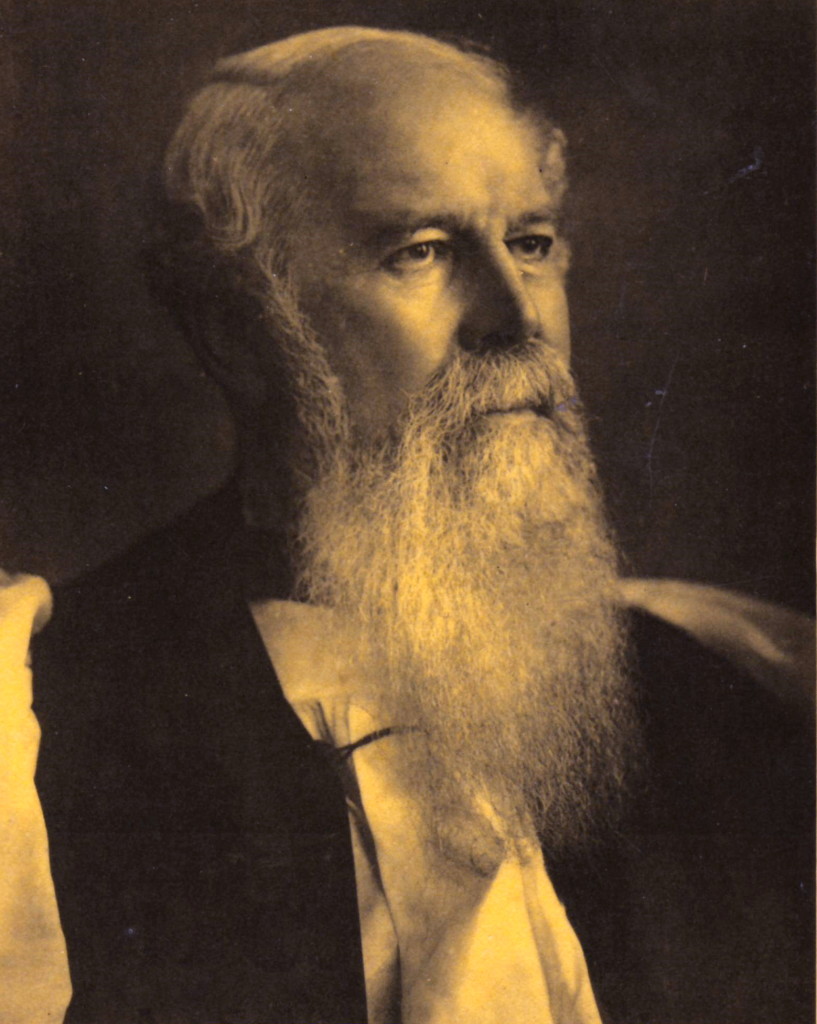
John Charles Ryle (10 May 1816 — 10 June 1900) was an English evangelical Anglican bishop. He was the first Anglican bishop of Liverpool.
Broadcaster:

Comments

0 / 2000 characters
Comments are moderated before appearing.

Be the first to comment!

Joshua

Joshua

Shall we play a game? Ask me about articles, sermons, or theology from our library. I can also help you navigate the site.