Bootstrap
Mike McInnis

Bearing Burdens #807

Mike McInnis July, 6 2021 Audio
0 Comments

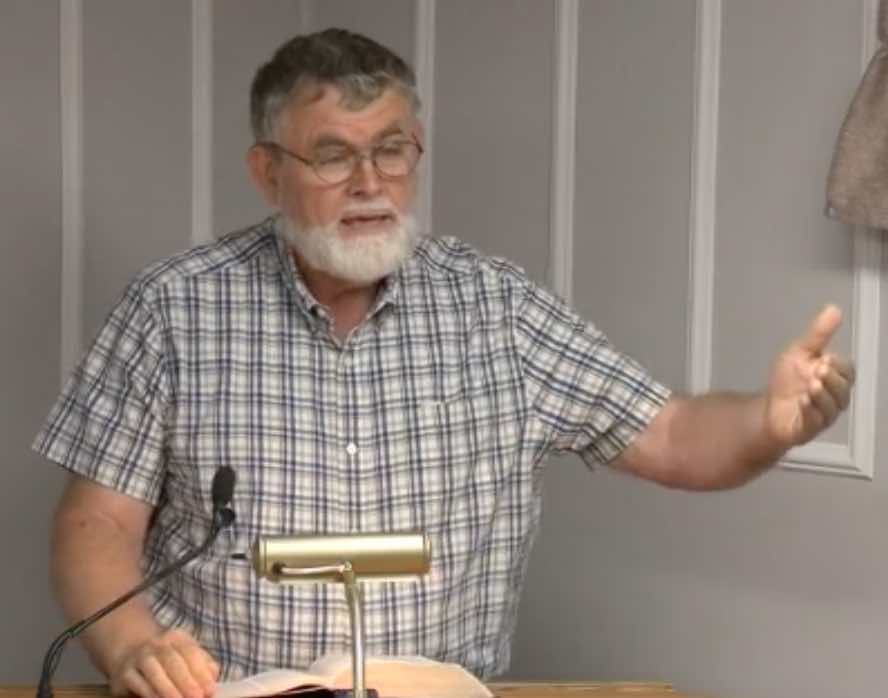
In the sermon "Bearing Burdens," Mike McInnis addresses the theological doctrine of Christian responsibility toward one another, emphasizing the significance of bearing each other's burdens as called by Christ. He argues that, through the redemptive work of Jesus, believers are set free from the law of sin and death and are given a new law—the law of love. This is supported by biblical references such as Romans 8:2, which illustrates freedom in Christ, and Galatians 6:2, which urges believers to bear one another's burdens. McInnis articulates that this compassionate action is a reflection of a new creation in Christ, distinguishing the behavior of the children of God from the self-centered tendencies of the flesh. The practical significance lies in the call for Christians to actively engage in mutual support and restoration within the church, all motivated by love rather than fear of punishment.

Key Quotes

“His redemption cannot, has not, and will not fail in any sense.”

“The law which binds them is the law of love which casteth out fear.”

“While the Scriptures say, for every man shall bear his own burden, they also instruct the sons of God to bear one another's burdens.”

“There is a sacred trust which is placed within the hands of the Lord's Church to minister to one another whenever any sort of need arises.”

Sermon Transcript

Auto-generated transcript • May contain errors

100%
Welcome, friends, to another
broadcast of Morsels for Zion's Poor. Jesus Christ came into
the world to save sinners, and His perfect work of redemption
has accomplished that task completely for all those for whom He lived
a sinless life and shed His precious blood. His redemption cannot,
has not, and will not fail in any sense. He has purchased not
only the deliverance of His people from the penalty of sin, but
from His power, which is the law as well. By His mighty power
and according to His timetable, He brings His children out of
darkness, by leading them to see His glorious light and delivering
them from the bondage of sin. In the process of setting them
free from that which held them captive, He has wrought in them
a new creation. Old things are passed away and
all things are become new. He writes His laws upon their
heart, stamps a likeness of Himself on this new man, and performs
deeds of righteousness in them which the written law could never
do. They are forever set free from
laws written in stone or engraved with the pens of men, and have
been brought under a new law or principle which guides and
empowers their steps. For the law of the Spirit of
life in Christ Jesus hath made me free from the law of sin and
death. For it is God which worketh in
you both to will and to do of his good pleasure. The concern
of the freeborn sons of God is to honor him who purchased their
pardon and set them free. That law which binds them is
the law of love which casteth out fear. Those who must be corralled
and restrained by the written law are those who are not acquainted
with the Redeemer. The New Testament is written
with this new principle of law in mind. The children of God
are exhorted to be obedient for an entirely different reason
than those who lived all their days under the shadow of darkness
and condemnation. We are admonished to love one
another, not out of fear of retribution, but because He has placed within
us a desire to walk according to Christ's example. I am somewhat
dubious of those who seem to easily disregard the instruction
of our Lord as if their obedience to Him is optional. As the sons
of God, we are given the charge to bear one another's burdens.
This is an awesome responsibility and an impossible task for the
flesh to fulfill on its own. The Lord Jesus left us His example
in this matter. As the sons of Adam, we are each
one primarily concerned with our own burdens, to the point
of having little, if any, concern for the burdens which others
bear. The free-born sons of God, however, are not to be satisfied
with this natural tendency, but have the exhortation and example
of Christ to concern ourselves as much with the needs of our
brethren as we do with our own. Wow! Talk about mortifying the
flesh! While the Scriptures say, for
every man shall bear his own burden, they also instruct the
sons of God to bear one another's burdens. A burden is a heavy
load. Often the prophets of old spoke
of having a burden from the Lord. A burden of this type, which
is a message from the Lord for a specific people, cannot be
borne or shared by anyone else. But there are burdens which we
are called to bear, that is, share with our brethren. We think
of the burden of sickness and affliction. We cannot literally
take upon ourselves a disease of a brother's flesh, but we
can pray for them and minister to them in the midst of their
trial. We can visit them in the time of their distress and encourage
them to trust in Him by our genuine concern. Some of the Lord's sorrow
in the Garden of Gethsemane was that his closest friends and
disciples could not even watch with him in the place of prayer
for a few moments and were oblivious to his suffering. We can share
with our brethren the burden of the weakness and failure of
the flesh. Brethren, if a man be overtaken in a fault, ye which
are spiritual, restore such a one in the spirit of meekness, considering
thyself, lest thou also be tempted. We shall probably all find ourselves
in a point of failure at one time or another. So rather than
rushing to judgment, we need to act in a spirit of forbearance
in order that the fallen brother might be recovered. This is not
about excusing sin or counting it a light thing, but has to
do with the attitude we all have about our own sinful flesh. If
we say that we have no sin, we deceive ourselves and the truth
is not in us. There is a sacred trust which
is placed within the hands of the Lord's Church to minister
to one another whenever any sort of need arises. Any sort of display
of these things beyond those sacred confines is a hellish
misuse of this trust. Those things never need to be
discussed with any who are outside of that brotherhood and are not
to be the subject of idle chatter even among the saints of God.
Do you love the brethren as Christ has given us example? For a free
CD containing 15 of these radio broadcasts, send an email to
forthepoor at windstream.net.
Mike McInnis
About Mike McInnis
Mike McInnis is an elder at Grace Chapel in O'Brien Florida. He is also editor of the Grace Gazette.
Broadcaster:

Comments

0 / 2000 characters
Comments are moderated before appearing.

Be the first to comment!

1
Joshua

Joshua

Shall we play a game? Ask me about articles, sermons, or theology from our library. I can also help you navigate the site.