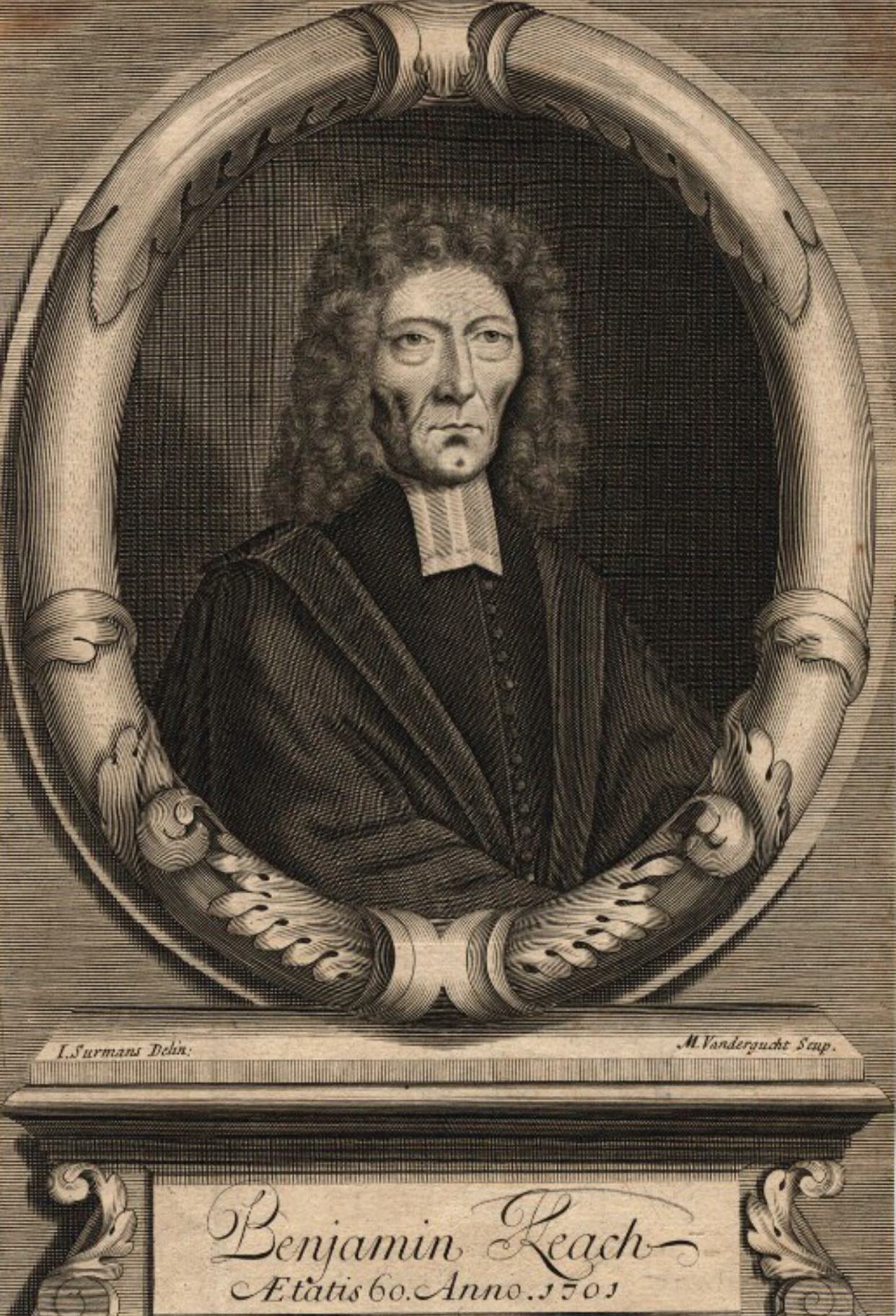
In Benjamin Keach's chapter "XX. of an Allegory," the author explores the nature of allegory within Scripture, defining it as a literary device where one thing is said and another is understood. He distinguishes between simple allegories drawn from natural elements and allusive allegories that reference other concepts or facts. Key arguments include the analysis of Genesis 3:15, where the enmity between the serpent and the woman is interpreted as a prefiguration of Christ's victory over sin and evil. Keach supports his discussion with multiple Scripture references, emphasizing the significance of metaphors in understanding the role of Christ as the Messiah and the ultimate defeat of Satan. This analysis holds practical significance in reinforcing the Reformed doctrine of redemption, illustrating God's plan for salvation through Christ's work and the assurance of believers' victory over sin.
Key Quotes
“An allegory... signifies that when one thing is said another thing is understood.”
“The first promise of the Gospel and the whole mystery of redemption to come is proposed by God himself in this allegory.”
“When Christ takes away sin he breaks the head of that infernal serpent.”
“Christ is proposed as a magnificent hero who as it were with his feet tramples on the serpent and breaks his head.”
What does the Bible say about allegories?
The Bible employs allegories to convey deeper truths through metaphorical language, particularly in the context of God's promises and redemptive work.
Additionally, in various passages such as Genesis 49:11-12, allegories illustrate future prophetic realities about the Messiah and His kingdom. Understanding these allegories enables believers to grasp the richness of Scripture and recognize the foreshadowing of Christ throughout the Old Testament narratives. It is essential for Christians to appreciate the use of allegory to deepen their faith and comprehension of God's Word.
Genesis 3:15, Genesis 49:11-12
How do we know that the allegorical interpretation of Scripture is true?
Allegorical interpretations of Scripture are validated through careful study and consistency with the overall message of the Bible and its theological truths.
For instance, in Genesis 3:15, the representation of the serpent as the devil and the woman as representing all mankind opens up understandings of sin and redemption. Furthermore, the continuity seen in the allegories throughout Scripture, such as those found in the prophecies concerning Jesus in Genesis 49:11-12, substantiates their allegorical meaning. By approaching interpretations with a reliance on the Holy Spirit and a commitment to systematic theology, believers can ascertain the accuracy and integrity of these allegorical readings.
Genesis 3:15, Genesis 49:11-12
Why is understanding allegories important for Christians?
Understanding allegories enriches Christians' appreciation of Scripture, enhancing their comprehension of theological themes and God's plan for salvation.
Moreover, by studying allegorical passages, believers can delve deeper into the themes of Christ's sacrifice, His kingdom, and the eternal implications of sin and redemption. For example, the allegorical declaration about the Messiah in Genesis 3:15 not only reinforces the doctrine of original sin but also the hope found in Christ. By recognizing and interpreting allegories, Christians enrich their faith journey, cultivating a desire for further exploration of God's Word and increasing their engagement with the transformative power of Scripture.
Genesis 3:15, Genesis 49:11-12
AAAHGOPIA, an allegory, with respect to its etymology or derivation, signifies that, when one thing is said, another thing is understood. It is the continuation of a trope, especially of a metaphor, and although metonymies, ironies, and synecdoches are likewise continued, yet not so frequently, nor with that emphasis, as in the other florid tropes, therefore we will in a particular chapter treat of this continued metaphor, not so much to show the fountains whence allegories are taken, (for that I presume is abundantly shown where we have treated of metaphors) but to discover aud explain some difficulties in it, and show its peculiar nature.
These allegories we will distinguish into simple and allusive. The simple we call such as are taken from any natural things. The allusive we call such as respect other things, whether words or facts, and are from thence deduced into a translated description.
Examples of a simple Allegory.
Ge 3:15, "And I will put enmity between thee (0 serpent!) and the woman, and between thy seed, and her seed; it shall bruise thy head, and thou shall bruise his heel." The first promise of the Gospel and the whole mystery of redemption to come, is proposed by God himself in this allegory. Here are almost all tropes in these especially the continuation of a metaphor. When Jehovah speaks to the serpent, he understands the Devil, either by a metonymy, because the Devil lurked in the serpent, and by it spoke to Eve; or by a metaphor, because the natural serpent was cursed by the word of God, verse 14. And so made abominable to the race of man, and so bore the figure of the Devil, whence the Devil is called a serpent and dragon, Re 20:2. By the woman mankind is meant (by a synecdoche) because mankind was to spring from those protoplasts or first-formed parents, Eve being called the mother of all living, Ge 3:20. The enmity denounced denotes the serious will of God to deliver men in due time from the power of the Devil; see Ac 17:26-27; 26:18. He mentions the woman only, because she was first seduced to sin, as she confesses, verse 13; and to provoke her the more against her conqueror. By the seed of the serpent, the whole power and troop of Devils and wicked men, who study the overthrow of Christ's kingdom, is metaphorically represented. By the seed of the woman, by way of eminency, kat ecoxhn, the Messiah, the Son of man, is metonymically understood, who also was to destroy the Devil's machinations. The enmity between him and the serpent's seed, intimates God's immutable decree of man's redemption by Christ. The metaphor is continued XXXX ipsum, It (that is, the XXXX semen, seed of the woman, mentioned immediately before) shall bruise thy head, and thou shalt bruise its heel. The first phrase (it shall bruise thy head) metaphorically declares, that Christ will destroy the power of the Devil, for as a venomous serpent when his head is bruised or broken, has neither strength or life; so the Devil's power being broken, they can no longer hurt or destroy men.[1] But more particularly,
[1] Vid. Gram. Sacr. Page 869.
By the head of the serpent is meant sin and death, for as the serpent's poison and power of biting lies in his head; so the Devil's poison is sin, which infects and destroys hence it is deservedly called the poison of dragons, and the cruel venom of asps, De 33:29, where note, that, in the Hebrew XXXX a [2] head is put for venom, and the epithet cruel, is added, as if there were a perfect allusion to the head of that most cruel serpent, Ge 3:15. Therefore when Christ takes away sin, he breaks the head of that infernal serpent: see Joh 3:8. And because the serpent's life and strength lies in his head, and because the head is the supreme and most noble member in a creature, by whose virtue and influence the whole body is governed, it is put for power, dominion, and superiority, De 28:13,44; La 1:5. The power, strength, and dominion of the devil against men, consists in death or killing, Heb 3:14. Therefore when Christ abolishes spiritual death, he breaks the serpent's head, (viz. his power to destroy men spiritually,) See 1Co 15:54. The other phrase (and thou shalt bruise his heel) denotes the manner and medium of effecting men's salvation, viz. his passion, and most bitter death. Christ is proposed as a magnificent hero, who, as it were, with his feet tramples on the serpent, and breaks his head. And as a serpent when trampled upon, resists with all his strength, while he has any life, wresting and winding himself, spitting poison, and biting his enemy; so Jehovah intimates, that the devil would do so, by his phrase; as if he had said, thou shalt defend thyself with all thy might, and use all endeavours to destroy thine enemy, the Messiah, (whilst I indulge thee for fallen man's sake to use thy worst), neither shall he escape unhurt, for he shall suffer a most ignominous death, by thine instruments: but this will not profit thee, for thou shalt not be able to touch his head, but only one of his heels, that is, the less principal part, will in some measure be hurted by thee; but my divine omnipotence shall cure that wound, by giving him a glorious resurrection from death, and by my Gospel, declaring him to the whole world to be conquerer of hell, and all its powers: whereas thou shalt utterly perish; not only thy heel, but the very head shall be broken.
[2] The same word in Ge 3:15.
We have insisted the larger upon this great oracle of divine truth, because it is the foundation of the prophecies concerning the Messiah, and all our hope and comfort, which we hope shall not seem tedious to the pious reader.
Ge 49:11-12, "Binding his foal unto the vine, and his ass's colt unto the choice vine; he washed his garments in wine, and his clothes in the blood of grapes,---his eyes shall be red with wine, and his teeth white with milk." In the last words of the Patriarch Jacob, there are many things spoken allegorically in this chapter, of which these words are most emphatical, which are spoken in the blessing of Judah; rabbies and some Christians understand by an hyperbole of an earthly inheritance and the great plenty and fecundity thereof; but verse 10 shows this to be a clear prophecy of Shiloh or the Messiah to come of the tribe of Judah; and surely the patriarch from so excellent a subject would not slip into the mention of those vain, earthly things,---and what he says of "the redness of eyes with wine," it is reckoned amongst wickednesses, Pr 23:29, because a sign of drunkenness, which the patriarch (who severely taxed his son's sins, verse 4, 5,) would not reckon among his blessings.
This is therefore an allegory, and is to this effect expounded by the learned Brentius.---"Binding his foal to a vine, this is a description of peace and tranquillity in the kingdom of Christ." See Jer 23:17, and Ec 3:10; for in wars, they do not bind foals or asses to the vines, when men cannot dwell under their own vine and fig-tree, which are destroyed, which denotes the peaceable administration of Christ in his kingdom. See Isa 9:5. This is not to be understood of external tranquillity, but partly because Christ establishes his kingdom without warlike arms, by the preaching of the Gospel; and partly because it brings peace and tranquillity of conscience. "He shall wash in wine," this is a description of abundance, and the vile esteem of worldly things in the kingdom of Christ. But we are to understand it of the abundance of spiritual things, as remission of sins, righteousness, &c. Mt 6:33; Ps 45:2, (&c.)
Some expound this of the passion of Christ;---the vineyard of Christ is his church, Isa 5:1; 27:2, and Isa 65:21; Mt 20:1; and Christ is the Vine into which the branches are grafted, Joh 15:1,4-5, and the meaning, say they, is, Christ compares his church (because of its simplicity, humility, and the burdens of trouble which it is forced to bear in the world) to an ass, which he will feed with most sweet grapes and spiritual joy, or inebriate it, that, being rendered courageous, it should despise death, devils, hell, and persecutions,---and so Christ will wash his garment in wine, and his clothes in the blood of grapes,---that is, will pour his most precious blood upon his garments, viz., his flesh, which his Deity puts on as a clothing, which will afterwards be excellent spiritual wine to comfort and refresh the faithful. "His eyes will be red with wine," that is, in his passion, for then he had no form nor comeliness, Isa 53:2, viz., when whipped, spit upon, and crowned with thorns, and carried about in disgrace by Pilate's order;---so he was deformed for other's sins. But inasmuch as "in him was found no spot, nor was guile found in his mouth," 1Pe 2:22. His teeth are said to be white with milk, verse 12. Whiteness signifies purity and innocence, &c., see Isa 63:1-3, (&c.)
Ec 12.; there is an allegorical description of old age and death. Verse 2, by "the darkness of the sun, light, moon, and stars," the languishing and consumption of vigour, strength, and judgment is denoted; verse 3, "by the trembling of the keepers of the house, and the bowing of strong men," the weakness of the hands, knees, and arms is signified (see Isa 35:3,) which are keepers of the body from hurt. "The ceasing of the grinders, because few," denotes the decay of the teeth, or their being almost gone. "The darkening of those that look out at the windows," betokens dimness of sight, the eyes being the windows of the body; verse 4, "the shutting of doors in the streets," betokens the contraction of the lips, and tiresomeness in speech. "The lowness of the sound of grinding," signifies debility of voice. "Rising at the voice of the bird," denotes want of sleep, for old men scarce sleep half the night, and are easily awaked by the cock's crowing. "The bringing low of the daughters of music," denotes dulness of hearing, and that those ears that could judge of music, delight not in it. (See 2Sa 19:35.) Verse 5, "to be afraid of high places," signifies difficulty of going. "The flower of the almond tree shall flourish," that is, grey hairs. "The grasshopper shall be a burden," that is, the back-bone shall bend and grow weak, so that it cannot bear any burden. "Desire shall fail," that is, appetite to meat, and other things, (2Sa 19:35,) then follows a description of death, &c. In the book of Canticles there are many continued metaphors or allegories that are very emphatical and obscure, yet contain many deep mysteries. It being a spiritual poem, setting forth the love of Christ to his church, &c., about which the reader is referred to our English expositors. See other allegories, Isa 28:20; Am 3:12; Isa 38:12; Jer 11:16; 12:5; Eze 16:3; Ho 13:15; Ecclesiastes 14:3, (&c.)
In the Old Testament you may find these allegories besides, De 32:13,15,22,32-33,41-42; 33:19-20,24-25; Jg 8:2, and Jg 14:18; 1Ki 12:11,14; 2Ki 19:3; Job 4:10-11; 20:12, (&c.,) Job 27:20, (&c.,) Job 29:14, (&c.,) and Job 38:9-10; Ps 23:1, (&c.,) Ps 51:8-9; 69:1-3; 75:8-9; 80:8, (&c.,) Ps 110:2-3; 123:3; Pr 3:8, and Pr 9:1, (&c.,) Ec 11:1, (&c.,) Isa 1:5-7,22; 66:6-7; 14:29; 30:33; 32:20; 36:6; 42:3; 45:8; 54:11-12; 55:1-2,12-13 and Isa 59:5-6; Jer 4:11-12; 5:6; 6:28-30; 12:9; 50:17; Eze 13:10, (&c.,) Eze 17:3, (&c.,) Eze 22:19, (&c.,) Eze 23:2, (&c.,) Eze 29:3, (&c.,) Eze 31:5; 32:3, (&c.,) and Eze 34. (&c.)
In the New Testament, Mt 3:10,12; 5:13; 7:3-6; 9:15, (&c.,) Mt 12:43, (&c.,) and Mt 15:13; Lu 9:62; Ro 11:16-18, (&c.,) and Ro 13:11-12; 1Co 3:6, (&c.,) 1Co 5:7-8, and 1Co 9:26-27; 2Co 3:2-3; 5:1, (&c,) 2Co 10:3-6, and 2Co 11:2; Ga 4:19; 5:15; 6:8-9; Eph 6:11, (&c.) The explication of all which, (at least for the most part) may be taken from our treatise of metaphors, that we shall leave them to be improved by the studious reader.
Examples of an allusive Allegory.
Ps 11:6, "Upon the wicked he shall rain snares, or coals, fire and brimstone, and the spirit of terrors, the portion of their cup," (so the Hebrew). This is an allegorical description of the grievousness of their punishment, by allusion to the destruction of Sodom, as Isa 34:9-10, (&c.,) see Ps 20:3, where by an allegory of "burnt-offerings," &c., prayers are meant. More examples, Ps 50:3, and Ps 55:9; Isa 10:24, where he alludes to Moses's rod; see verse 26, Isa 24:18, with Ge 7:11; Isa 26:14, with Ex 14:13; Isa 30:22, with Ex 15:20; 1Sa 18:5; Ps 68:25-26, with many others.
In the New Testament you have these examples, Mt 5:22, which allegory alludes to the form of civil judgments amongst the Jews, and their punishments. Mt 6:17, Christ alludes to the hypocritical practices of the Pharisees, who deformed their faces when they fasted, verse 16; the sense is, that you must not imitate them.
In New Testament worship, there are frequent allusions to that which is proper to the Old Testament, as was shown, chap. xiii., of a metaphor, Isa 4:5, there is an allegorical description of God's protection of his church by allusion to the pillar of a cloud and fire, Ex 13:21, see Isa 11:14-16, and Isa 52:11, with 2Co 6:17; Isa 54:1,4-6, see Ga 4:26-27. There are other allegories, Isa 54:2, from enlarging of tents; from the inhabiting of desolated cities, verse 3, 5; laying the magnificent foundation, verse 11, 12; (where there is withal an hyperbole,) see Mt 16:18; Eph 2:20-21, from the abolition of hostile instruments, verses 16, 17. See Isa 61:6-9, see Ho 2:15; Am 9:13-15, Ecclesiastes 14:10-11; 2Co 3:13, where is the description of the New Testament church; there is an allusion to the vail of Moses, see Joh 9:28, (&c.,) the sense of which allegory is, that as the Jews could not behold the face of Moses because of the vail; so the carnal Jews (those Xristomacoi, enemies of Christ) could not see the splendour of this spiritual Moses, (that is, the chief end and scope of his writers) and do not understand that Jesus Christ is our Saviour, because of their willing blindness of mind, which as a vail keeps the shinings of that light from their hearts, which cannot be taken away but by true conversion. Then, by way of antithesis, says, verse 18, that we (viz., his disciples) with open face behold his glory, &c. See verses 7-9, 18, Ga 4:28,31, with verses 22-24. See also another allegory, Re 7:15, where there is another allusion to the Levitical ministry in the Old Testament temple.

Comments
Your comment has been submitted and is awaiting moderation. Once approved, it will appear on this page.
Be the first to comment!