Bootstrap
W.E. Best

#5 - Isaiah 53 - The Sin-Bearing Savior

Isaiah 53:6
W.E. Best July, 1 1988 Audio
0 Comments
Best on Isaiah 53

Sermon Transcript

Auto-generated transcript • May contain errors

100%
Open your Bibles to Isaiah chapter
53. Last night I was reading two
different men whom I know. One I know personally, and the
other I do not know personally, but I do know quite a bit about
him. As I was reading the works of
these two men on a certain passage of scripture, my heart was touched
greatly by the writing of one of the men. Even though the other man made
some good statements, I was not touched in the same manner. I believe that a person's character can be reflected even in the
writing that a man does. I'm sure that's the reason that
I appreciate reading Arthur W. Pink as much as I do. There are
the men who have written excellent works. And yet, they may not
make the same impression upon my mind and heart that someone
whom I feel to be a deeply spiritual person. If the person is deeply
spiritual, it will be reflected in what he has to say. As we continue to look at Isaiah
53, we have come now to verse 6. And this verse, a very familiar
passage to all of us, to have been saved for any length of
time, but yet I am afraid that we have overlooked or we have
failed to see some of the great truths that are contained in
this familiar text of scripture. As I have done before in our
study of Isaiah 53, I want to continue to do this morning, review briefly what we have already
given on the five preceding verses by emphasizing the important
point of each verse. And then as we read verse 6,
I will give in connection with each phrase of this verse a New
Testament text that serves as a divine commentary upon this
passage. Let us read beginning with verse
1. As we read each verse, I will point out the important point
of the text. Who hath believed our report? to whom is the arm of the Lord
revealed. Jesus Christ is introduced in
verse 1. For he shall grow up before him
as a tender plant, and as a root out of a dry ground. He hath
no form nor comeliness, and when we shall see him, There is no
beauty that we should desire him. The Lord Jesus Christ was misunderstood according to verse 2. Verse 3, He is despised and rejected
of men, a man of sorrows and acquainted with grief. and we
hid as it were our faces from him. He was despised and we esteemed
him not. The Lord Jesus was rejected by
men. Verse 4, Surely he hath borne
our griefs, and carried our sorrows. Yet we did esteem him stricken,
smitten of God, and afflicted. The Lord Jesus Christ was the
sympathetic sufferer during his personal ministry. Verse 5. He was wounded for our
transgressions. He was bruised for our iniquities. The chastisement of our peace
was upon him, and with his stripes we are healed. The Lord Jesus suffered vicariously
on the cross. Now, verse 6 explains the reason
of the necessity of his vicarious suffering that is expressed in
verse 5. All we like sheep have gone astray. We have turned everyone to his
own way, and the Lord hath laid on him the iniquity of us all. In the first part of verse 6,
all we like sheep have gone astray. Romans 3.23 states that all have
sinned and come short of the glory of God. The next statement, we have turned
everyone to his own way. Philippians 2, verse 21, tells
us that all seek their own and not the things of Christ. Finally, And the Lord hath laid
on him the iniquity of us all. In 2 Corinthians 5, 21, For him
who knew no sin was made to be sin, or made a sin offering,
that we might be made the righteousness of God in him." In verse 6, we
are told that all in themselves go astray. And in the same verse,
in Christ, we are gathered together. In ourselves, we go astray, each
one in his own separate way. In Christ, we are gathered together. Verse 6 is one of the great texts
of Holy Scripture. It contains so much wealth in
it. that I approach it this morning
with fear and trembling, lest I should miss one of the important
points in this verse. Verse 6 shows the necessity of
the sufferings of Christ, which are spoken of in verse 5. It is because men are wholly
estranged from God, that Jesus Christ suffered and died. There was sympathetic suffering
during his personal ministry. Then there was vicarious suffering
when he was suspended between heaven and earth, on the tree,
as we are told in 1 Peter chapter 2 and verse 24. The picture before us is that
of scattered sheep. When you look at the statement,
sheep, all we like sheep have gone astray. Not all mankind are referred to as sheep. There are sheep and there are
goats. You will observe, I said, all
men without exception are not called sheep in the scriptures. Please follow me. This is a statement
that is misunderstood by most religions. Persons who quote this verse
frequently, in the religious world or, I might say, in the,
quote, secular church, end of quote, do not know its real meaning. The Bible speaks of sheep and
goats, but sheep are referred to in the
scriptures under two headings. Number one, law sheep. and number
two, saved sheep. You're looking this morning at
the confession of penitent Jews. They had been brought to the
place where they realized how they had misunderstood the Lord
Jesus Christ and his suffering. They had been brought to that
place because there had been a change wrought in their hearts. In other words, they had been
regenerated. This is the penitential confession
of lost sheep, fallen, who have become saved sheep because they
have been regenerated by the Sovereign Spirit. In their confession, they said,
Oh, we like sheep have gone astray. We have turned everyone, each
one, to his own particular way. Notice that. The scattering is not only general,
but it is even particular. Therefore, no person can offer
an excuse for having gone astray. He is responsible for having
gone astray. He can't blame it on Adam because
each one has gone his own particular way, the second phrase, and that
is overlooked by most persons. who quote this passage of Scripture. I said sheep are divided into
two categories, law sheep and saved sheep. The Lord Jesus,
when he gave the commission to the disciples in Matthew chapter
10, admonished them, according to
verse 6, to go only to the lost sheep of the house of Israel."
As they went out from the presence of Jesus Christ, they were not
to go by way of the Gentiles, they're told in that passage,
but to go to the lost sheep of the house of Israel. In John 10 and verse 16, the
Lord Jesus is speaking. He said, Other sheep I have. Notice the tense of the verb. Other sheep I have, which are
not of this fold. They are not of Judaism, but
I will bring them, and all of the sheep, whether they be sheep
from among the Jews or Sheep from among the Gentiles, lost
sheep but regenerated by the Spirit of God, thus becoming
saved sheep, and they will constitute the one flock, and I will be
their shepherd. Other sheep I have." Now, they
were not saved sheep when Jesus Christ spoke. concerning the
lost Gentiles, but they were his sheep. They were lost sheep
whom he would redeem by his death and the Holy Spirit would regenerate
and apply the redemptive work accomplished by Jesus Christ
in time. Therefore he could speak of them
as my sheep. So we have the confession of
penitent Jews. You will also notice in verse
6, it is not the wandering of one out of a hundred that we
have in the parable of Luke 15, but here is the wandering of
all the sheep. All we like sheep have gone astray. Then we have turned every one,
each one, to his own way, or his own particular way. Here is the whole flock of sheep
that are Christ's because given to him by God the Father in the
covenant of redemption. It is of great importance to
notice that the only office Isaiah describes is that of suffering. The Lord Jesus is presented here
not as a teacher, he is presented not as a lawgiver, he is presented
not as a king, but he is presented as the suffering Savior. I read recently word that the
rabbis have a legend far wiser than most of their followers. And when I use the word rabbi,
I'm talking about an Orthodox Jew who is a rabbi of his particular
temple. I said the rabbis have a legend.
far wiser than most of their followers. I use the word followers
for the simple reason that the Orthodox Jew today does not embrace
Jesus Christ as the eternal Son of the living God. He does not
believe that Messiah has come as the suffering Savior. He talks
about the coming of the Messiah And he believes that he shall
come someday. And when he comes, he will come
in power and great glory. You and I believe that with all
of our hearts. But we believe something the
Orthodox Jew does not believe. We believe that he has already
come. He has already suffered. He has already borne our sins. in his own body on the tree.
Therefore, he is our sin-bearer. He is our substitute. He is our
surety. He is our mediator. He is our
intercessor. And when he comes the second
time, he will not come as the suffering Messiah. He will come
as the reigning king. Now the latter is accepted by
the Orthodox Jew, whereas the former is rejected, even to this
very day. So their legend, which I said
is wiser than most of their followers, states, and I'm quoting their
legend, their legend states that Messiah
is to be found among the lepers at the gate of the city. That's a Jewish legend. The Messiah
will be found sitting with the lepers at the gate of the city
of Jerusalem. One who has commented on that
legend has said, and I quote, The fable has in it the deep
truth that Jesus Christ who saves must suffer with and for whom
he saves." A good statement. He simply interpreted the legend
that the Orthodox Jew fails to see the real significance of
his own legend. We have seen that the speakers
in this verse of Scripture are the Jewish penitents. They have
learned how much they misunderstood the Lord Jesus Christ when he
came as the sympathetic sufferer during his personal ministry,
verse 4, and the vicarious sufferer in verse 5. But I must hasten to say the
spiritual application of this confession by penitent Jews applies
to all penitents, whether Jews or Gentiles. I confess that there was much
misunderstanding, on my part, concerning the person and work
of Jesus Christ unto the Spirit of God wrought a change in my
heart. You will admit, just as the penitent Jew confessed, that
you too had false conceptions concerning the person and work
of Jesus Christ before you were regenerated. There are many people
today who talk about the Lord Jesus as a good person, as a
moral individual, or as a good prophet, on and on they go. And
many religionists even refer to him as the peccable Christ. And then when one asks for an
explanation of that term, the reply often is, well, he could
sin, but he didn't. Now, that is the confession of
a person who is ignorant of the person of Jesus Christ. And I
say that without any apology. the mistaken view of Christianity. Notice what I said, the mistaken
view of Christianity is failure to see the true meaning of verse
6. Now, what is the true meaning
of verse 6? First of all, we have depravity. Many people talk
about depravity, but they do not believe in universal depravity. Not only is depravity spoken
of in this text, but the redemptive work of Jesus Christ is also
given us in this verse of scripture. Misunderstanding on depravity
and the redemptive work of Jesus Christ, those are the two things that are misunderstood by most
religionists And such misunderstanding is at the very foundation of
all false doctrine. The evil which we all do goes
forth from us in the form of a deed, but it comes back upon
us in the form of guilt. Notice what I said. Evil, which
goes forth from us, goes forth in the form of a deed. But it comes back upon us in
the form of guilt. It must not be overlooked that
the evil which goes forth from us is from a heart that is innately
evil. The other day my wife and I were
listening to the news, and some woman who was head of some political
party on the East Coast had been asked a question about a certain
candidate, and she made the statement that all men are evil by nature."
I said, that's the first time I've heard a statement like that
coming from one who is interested in politics. She went on to talk
about, we're all innately evil. You say, well, that's political,
preacher. You can call it whatever you want to. I'm just using it
as an illustration, but I think it's timely. I think it's a timely
illustration. So the Jews, the penitent Jews,
had a mistaken view about Jesus Christ, and they confessed it.
There was repentance on their part. And I must remind you that
there is genuine repentance in the heart of every person where
grace is objected. Where there is no grace operating,
there is no spirit of repentance. But wherever grace operates,
there is repentance. And where there is no spirit
of repentance, it is because grace is absent. Let's look at the outline of
the verse, a very simple outline. When we look at the very first
phrase, all we like sheep have gone astray. Here's the point. Depravity is
universal. But wait a minute, preacher.
The we and the all are this verse. The words are restricted to the
penitent Jew, and you're right. Are you following me? All we like sheep have gone astray. I said the words all and we. They are restricted to the penitent
Jews. How can you talk about universal
depravity, since the program WE is restricted to the penitent
Jews? Listen to the full title of my
first poem. Depravity is universal, therefore
it includes the law seat. Do you see how I stated it? That
privacy is universal, therefore it includes the lost sheep. All of us who are saved and are sitting here enjoying
spiritual things this morning, we must not lose sight of the
fact that we too were depraved. As lost sheep we were depraved. But we were lost sheep. We were
sheep because we had been given to Jesus Christ in the covenant
of redemption. But as lost, as depraved, as
the ghosts, those that are not given to Jesus Christ in the
covenant of redemption. Do you see there what all is
involved in this verse? There is much more than what
appears by just a casual quotation of the text. So depravity is
universal. We've all seen and come short
of the glory of God, and Paul was writing Gentiles in Romans
3.23. And here we have a confession
of penitent Jews. That's my confession. That's
your confession. So depravity is universal, therefore
it includes lost sheep as well as goats. All we, like sheep, have gone
astray. Departure from God is represented
by the straying of sheep. Thomas Boston and some of the
other Puritans The text implies the sheep were
once in the fold. Now, you say, I don't quite understand
that. How in the world could these
sheep at one time have been in the fold? How could they have
strayed from the fold since, as lost sheep, we were depraved? And it was not until we were
regenerated that we were brought into the fold. Now, can you explain
that? You see, I'd never seen that
before in this verse of Scripture. It did. The Puritans were right
by saying that there is a straying represented in this particular
statement by Isaiah the prophet. who gives the quintessential
confession of the Jews. They were at one time in the
bowl, and they have strayed from the bowl. How does one explain
that? Well, Beloved, it can be explained. Do you remember our series of
messages on imputation? This is explained. in our study
of education. But we'll reflect just briefly
on one point to show you what the Puritans had in mind when
they talked about this. Someone has raised the question,
how could this be? Since we're all sinners from
birth, and since we're all sinners from birth, how could we have
ever been in the boat? Let's go back to Adam. Here's
where imputation comes in. Here's where an understanding
of biblical imputation is necessary. We all sinned in Adam, did we
not? Romans 5, 12. Now you remember
what we have said about it. Imputation. the imputation of
original sin to us, real and immediate, real, because we sinned
in Adam. And that is what is stated in
Romans 5 and verse 12. Thus in Adam we all went astray. You understand that? In Adam we went
astray. Adam was in the fold. He was
in the fold in a state of uprightness. He was in the fold in a state
of created uprightness. Now, all who are in Jesus Christ
are in the fold because we are in a state of We are in Jesus
Christ. When Adam went astray, we all
went astray in Adam, so the Puritans were right. No creature is more
prone to wander and lose his way than a sheep without a shepherd. What happened when Adam fell?
The first thing he did was to sought to hide from God, so he
headed for the kitchen, so to speak. I said he headed for the
kitchen. Did he ever seek the Lord? No.
The Lord sought him out and found him. As sheep, we have all wondered. and there will never be any returning
to the foal on the part of any sheep who has wandered away in
Adam." The mission of Jesus Christ according
to John 19, verse 10, I am come to seek and to save that which
was lost. You see, that text harmonizes
with what we're talking about. When the word of God is rightly
divided, all scripture will harmonize. Jesus Christ is the speaker.
Let's go to Luke 15, that familiar parable. The 90 and 9, all of
us are familiar with it. What did the Lord Jesus do? He
sought the Lord's sheep until he found it. And when he had
found it, what did he do with it? He laid it upon his shoulder, and he took it with him. He bears us on his shoulder of
strength. He is our strength. So no creature is more prone
to wonder and lose his way than a sheep without a shepherd. What
about the sheep that has returned to the fold by the grace of the
Sovereign God? He can say in the language of
1 Peter chapter 2. And I think it's verse 26. We have returned, said Peter,
to the shepherd and bishop of our souls. We did not return
in our own strength. We had no desire to return, but
the seeking Savior sought us out, found us, put us on his
shoulder, and brought us to the fold. Is this the teaching of
Scripture? It surely is all of Scripture. The lost sheep is unable to return or to bring himself into the
right way again. According to the religious philosophy
of our day, the Lord's sheep is capable, by his own faith,
to turn and to go or to walk an hour. But that is not the
teaching of Scripture. Jesus Christ is the Seeker, and
he is also the Savior. The sheep is unable to go in
its own strength into the right way. We know that the Lord's
sheep is ready to follow evil examples. Why? Because his disposition is evil. I don't know when we as parents
are going to quit saying, I just don't understand my child or
my children. We've given them good instruction
Why would they turn from good instruction and turn to evil
instruction? Well, beloved, it's because we're
not really embracing the biblical doctrine of depravity. The disposition
of evil. That's why a child, as soon as
it is born, comes into the world line. The other day, a little girl
about three years old, living down the street from us, was
wandering around the street her mother works. And I suppose the
lady who is keeping her during the daytime while the mother
works, let her get out and didn't pay any attention to her. So
she just, she was bad about just wandering around, goes in one
house and out of another and in another and out of another.
And so she was in one house, and she was going to clean it.
She had a razor blade. And they had just hung wallpaper in this
new house, so I said, sweetheart, I said, you better go home, you
know. Wow, the builder told me I could do this. And my mother
told me I could do it. And I said, no, I don't believe
that. You know, see, the builder did. He told me I could do this,
about three years old. And I didn't say, now, you're
lying through your teeth. I didn't say that, but I knew
she was. So I walked, I was walking around, I walked down the street
and so a mother had come in from work and the mother came out
and said, get out of that house and come here. Please hear, mother
didn't tell her it was all right for her to do that. So here was
a little three year old girl wandering around from place to
place and when I asked her, I said, you better go home, you shouldn't
be in there. My mother told me I could and the builder told
me I could. So a child just comes into the
world lying And that's what we're told in the Book of Proverbs.
So, the reason that a child will follow evil influence is because
the child perceives an evil disposition. Why, you can teach a child to
sing biblical songs and quote biblical phrases, but I'll tell
you what the child will remember more than anything else, bad
language. Bad language. So the lost sheep
can wander, wander by himself, but he cannot return by himself. So the lost sheep never return.
until the sheep has been sought and found by Jesus Christ, who
has come the first time for that very purpose. You notice here we have an indictment. Departure from God is an indictment. All we like sheep have gone astray. Obligation has been violated.
Guilt has been contracted. Adam ought to have remained in
the fold. Notice what I said. He ought
to have remained in the fold, but he didn't. But due to his
self-chosen course, the state of man now is one of error, sin,
helplessness, and alienation from a righteous and holy God. Oh, we like Jesus Christ! Let's look at the second part
of this verse. And this really is important. Modes of depravity's
manifestation are many. In other words, there are many
manifestations of depravity, or many modes of depravity manifestations. We have turned everyone to his
own way. Let's investigate this, because
I think this point is not emphasized as much as it ought to be today.
All have wondered, but each in his own way. We're not only involved in the
sin of the mass, or we like Keith have gone astray, the first statement,
but we stand under a load of personal and individual guilt. We have turned everyone to his
own way. Look at that. That makes you
responsible. So no one can excuse himself. No one in this auditorium can
excuse himself. No sinner can excuse himself. Everyone has his own errors,
his own sins, his own miseries, and his own dangers. The forms of human sinfulness,
one has said, are as varied and numerous as are men's natural
inclinations. Our truth. We have all gone in
the path which, notice here, we have chosen. In other words, each person has
gone the way which he himself has chosen. There are many different
ways that the tragedy manifests itself. There are some who like
pain, and they would do anything to gain pain. And so he has gone
in that particular way. Another person desires fortune. and he would sell his soul for
a mess of cotton. So he has gone in the way of
fortune. Another has gone in a different
way. But of all the ways that we might describe to you, the
most heinous way of all is the religious way. Did you get what
I said? The religious way. Do you remember what the Lord
Jesus said in the 21st chapter of the Gospel according to Matthew?
He was speaking to the down-and-outers, so to speak. He was speaking
to those who were immoral. And then he spoke to those who
were morally upright. They were religious preachers. They're idols. There are those
who make denominations. They're idols. There are others
who make religious activities. They're idols. And you know as well as I do
that to try to witness to people who make religion their idol
is a very difficult task. Read the seventh chapter of the
Gospel according to Mark for an account of it. There are such idols as activities,
there are such idols as music, and on and on we could go. And
every person thinks that what he is doing is right, and it
is in his own estimation. But his own estimation is evil,
because it comes from an evil disposition. There is a way that seemeth right
unto a man, But the end, thereof, we're told in Proverbs 14, 12,
are the wave of death. Departure from the fold means
departure from brotherhood. Let's look at this. I haven't
seen this until just a recent study of this second phrase of
verse 6. Notice, all we like keep upon
a strain. We have turned everyone to his
own ways. One Puritan called attention
to this. He said, whenever a person departs from the fool, there
is departure even from one another. And that's why we're living in
a world that is manifesting itself by selfishness. And you know as well as I do,
that's rude. That's what we're faced with
today. And that is predicted by Paul,
that very thing was predicted by the Apostle Paul in his second
letter to Timothy. In the last days, perilous times
shall come. Men shall be lovers of themselves. lovers of themselves. I can illustrate it in this manner.
You take, we're living in a time when, for instance, there are
a number of subcontractors, for instance, who will build a home.
One subcontractor will go in, he'll do his job. The next subcontractor
will come along. I've been confronted with this
in recent days. And he doesn't care if he undoes
what the other man has done before him. In other words, if he messes
up what the other fellow has done, it doesn't make any difference
to him. And then the alibi will be, well,
he does it to me all the time, so I don't care. Now, this is
the attitude. In other words, there is no pride
in working. So one fellow come along, he'll
do his job. Maybe he'll be neat with his
job. The next fellow come along and he has to go over maybe what
the fellow has done, so he will do something destructive to what
the fellow before him has done. And he doesn't care. He doesn't
care at all. I can illustrate that by the
attitude that fellow had. I think it was the man, this
was before he moved in to the new house, the copper tubing
coming out from the wall, the brick wall, for the air conditioning
unit. And evidently when the man on
his little tractor that was doing the grating around the house,
he was ripping and snorting, you know, and not really paying
any attention, and so he hit the copper tubing and Bennett,
of course, when the air conditioning man came to install the compressor,
he looked at that and he said, hmm, so what did he have to do?
He had to knock out a big hole in the brick wall to get up in
there to fix his copper tubing. And so it didn't make any difference
to him because he had to do it. But you see the man who was using
the tractor, he didn't particularly care, just so I'd get the grading
done. And so this is what we're saying here today. Everyone to
his own way. And then the Puritan called attention
to this. He said, Selfishness is the leading principle of unredeemed
men. Really? Selfishness is the leading principle
of unredeemed men. They live for themselves. They do not live for a common
cause. Now, let's illustrate something.
It doesn't make any difference what our government tries to
do, beloved, for the down-and-outers and so forth. Everyone is living
for himself if he possesses not the grace of God. That's the leading principle
of all unsaved people. And this is what Paul said in
2 Timothy 3, verse 2, lovers of their own self. I don't care who else it hurts,
just so I get my way. That's the cause of divorces
today, that's the cause of homes being broken up, that's the cause
of all the trouble. and selfishness is the leading
characteristic of one who is a stranger of grace. So when
we look at the second phrase, and everyone to his own ways, living for himself, living for
number one. When we have been gathered in
the fold, that's The Christian doesn't just live
for himself, he lives for Christ and he lives for others. In fact,
in the Christian it's like this, Christ first, others, and then
for myself. See the difference? That's the
difference. That's what grace does to an
individual. Now let's look at the last phrase.
The Lord laid on him, that is, on Jesus Christ, the iniquity
of us all. You'll notice the text opens
with a confession of sin, which is common to all who are regenerated. The confession, you'll also observe,
is special and particular. It contains no idea of extreme. Please observe what I say. It
contains no idea of excuse. Only like Jesus gone astray,
we have turned everyone to his own way. No excuse there. And
beloved, there is no excuse in the heart of a truly repentant
person. You notice the verse closes with
a most grievous and yet the most charming statement of all three
statements in this verse. I said the most grievous and
at the same time the most charming. Strange is it where sorrow reaped
its climax. There is There it is where the
weary soul finds rest. Where do you and I find rest?
It is where sorrow meets its climax. It is at the very point
where the sufferings of Jesus Christ met their climax. I wish I had time to review what
I touched briefly on last Wednesday evening. Last Sunday morning,
you remember, we made a study of King Ahab. But I didn't touch
this because in the 7th chapter of the prophecy of Isaiah, Isaiah
was told to take his son Tiardias, and go to the end of the conduit." The end of the conduit, or the
acrobat. And he was to take his son, whose
name meant what? The name T.R. Jacob means, a
remnant shall be saved. There Isaiah stood, proclaiming
the message of God. at the very place where the life-giving
waters from the upper pool emptied themselves into Jerusalem to
sustain the people therein. That signifies what? It was at
the very place where all of the sorrows and the sufferings of
Christ climaxed. that you and I receive our joy,
our peace, our contentment. For Jesus Christ said, it is
finished. It is finished. I could go on. There are many other tremendous
truths in that passage, but we don't have time to elaborate
on that. The Savior bruised is the healing of bruised hearts. And this, beloved, we must have
low thoughts of ourselves before we will ever have high thoughts
of God. And when I read where religionists
have such high thoughts of themselves, I know they have very low thoughts
of the God whom I love and cherish. The Lord hath laid on him the
iniquity of us all. Let's hasten in bringing this
message to a close, but this is, this is the most important
point. You notice the marginal reference. The Lord calls to meet. The Lord
calls to meet. The Lord caused to me all the
sins of all the saints upon Jesus Christ. And there on Calvary
he paid the debt that was against all the sheep." John Gill stated it like this
in his commentary. He said, "...the sins of the
elect are represented as coming from all directions, north, east,
south, and west. As I read that, I could not help
but add to that phrase, yes, and from the past, present, and
future. So I added the phrase. So it should be said that the
sins of the elect are represented as coming from all directions,
northeast, south, and west, and from all time, past, present,
and future, and meeting upon Jesus Christ,
causing the death of the Son of God. for the Father's satisfaction
and for our salvation." And you notice I said, for the
Father's satisfaction and for our salvation. Look at the word,
iniquity, for a moment. All the sins of the elect are
collected together and expressed by one word in this passage,
iniquity. Thus iniquity could be transferred
from one being to another being, whereas an act of iniquity could
never be thus transferred. Did you observe what I said? The iniquity was transferred,
but an act of iniquity could never be thus transferred. So
Jehovah, God, instead of allowing the elect to be devoured, fed
not his son, but gave him up. And that, for us all, according
to Romans 8.33-34. Here the Lord Jesus Christ is
the good heifer who gave his life for the sheep. Iniquity,
in the sense of punishment, could and was transferred to Jesus
Christ. But iniquity, as an act of evil,
could never be thus transferred. It was the punishment for iniquity
that Jesus Christ bore on the cross of Calvary for you and
for me. What about the statement, let
every one bear his own sin? What about that statement? I
can illustrate it. There are some who do not like
the idea, and I'm talking about religionists, who do not like
the doctrine of iniquity. And they say, let every man bear
his own iniquity or his own sin or his own punishment. And they
think it's foolish. for Jesus Christ, the Son of
God, to bear the sins of his people. I can illustrate it in
this manner. If you were to borrow some money
from me, And then you were to come back to me at a later date,
and I knew that you had the money to pay the debt, and you said
to me, will you cancel it? Will you cancel my debt? My reply
would be, no, I'll not cancel your debt. You have the money
to pay the debt, so pay your own debt. You see, that's not
the same. As sheep, we have gone astray.
We're incapable of returning. We can't return. We're unable
to return. Now let's use another illustration.
Suppose I'm driving down the freeway and there's been a serious
automobile accident. And I see a person laid out on
the street and I stop to give help. Suppose I were to walk
up to the person who is lying there and I would say, get up
from there and get to the hospital. I wouldn't be there. Neither would you. I knew that the person is incapable
of getting up. I knew that the person could
not get up and go to the hospital. But what would I do? There is
something within me and there is something within you. You
would want to do all that you could to help that person to
get to the hospital. Now let's get the picture. All we like sheep have gone astray. We have turned everyone to his
own ways. You can't return to the fool.
You don't have the ability to do it. You're totally depraved.
Totally depressed. It is not like you, borrowing
some money, as I said a moment ago, you have the money to pay
your debt, but you say, will you cancel my debt? But it's like the person who
has been seriously wounded in an accident and cannot get up
off of the street. and go to the hospital, that
you're willing to do something to assist that person to get
to the hospital for help. Luke 10 gives the story, the
story of the good Samaritan. There was a certain man who went
from Jerusalem down to Jericho, a place of blessing to a place
of curse. We have all gone in Adam from
a place of blessing to a place of curse, by nature. By nature
we're in a place of curse. The priest comes along, he can't
give any assistance. The Levi passes by on the other
side, he cannot assist. But a certain man The good Samaritan
came along, and he saw him in this condition, and what did
he do? He saw him wounded and left half dead, unable to help
himself. He poured him in oil and wine,
raised him up, placed him on his old beast, took him to the
inn, and told the innkeeper, take care of him. And when I
return, if I owe you anything, I will repay you. All of the sins of all the elect
of all times have been made to meet upon Jesus Christ at Calvary,
and there he paid the debt. And you and I are the recipients
of that accomplishment. It is finished, said Christ.
The Father is satisfied. The Father is satisfied, and
so am I. Are you? I'm closing. Look at the text.
All we like sheep have gone astray. Universal depravity, therefore,
even the sheep, the Lord's sheep, are depraved. We have turned
everyone to his own particular way. I don't know what way that
you might be going, but you're going in your own way, your own
self-chosen way. But the Lord hath made to me,
upon Jesus Christ, the iniquity of all, and that doesn't include
all mankind. That does not mean every person
without exception. Keep it within the context! The iniquity of us all! Who's
confessing? The penitent Jews! And that's
the confession of every repentant person. And Jesus Christ only
bore the sins of those who have and those who shall manifest
repentance of their sins and rejoice in the salvation accomplished
by Jesus Christ on the cross. I say that this verse is a great
test system. We're going to stand and sing
it. What's the song, Brother Brennan?
W.E. Best
About W.E. Best
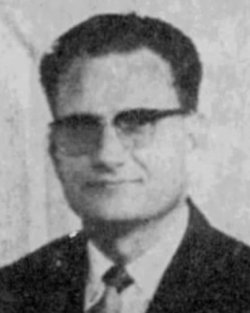
Wilbern Elias Best (1919-2007) was a preacher and writer of Gospel material. He wrote 25 books and pamphlets comprised of sermons he preached to his congregation. These books were distributed in English and Spanish around the world from 1970 to 2018 at no cost via the W.E. Best Book Missionary Trust.

Comments

0 / 2000 characters
Comments are moderated before appearing.

Be the first to comment!

Joshua

Joshua

Shall we play a game? Ask me about articles, sermons, or theology from our library. I can also help you navigate the site.