Bootstrap
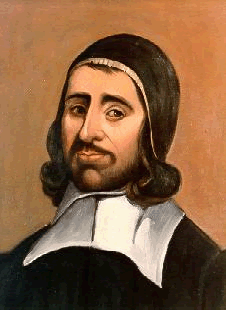
Richard Baxter

Self Denial

Luke 14; Mark 8
Richard Baxter October, 25 2007 Audio
0 Comments
A very practical and powerful sermon on a vital area!

In Richard Baxter's sermon "Self Denial," the main theological topic addressed is the necessity of self-denial in the Christian life as a fundamental aspect of true discipleship, particularly in light of Jesus's calls in Scripture. Baxter argues that selfishness is one of the most dangerous sins and emphasizes the need for believers to regularly examine their priorities and desires in relation to God. He discusses several Scriptural references, notably Luke 9:23, where Jesus invites His followers to deny themselves and take up their cross, using these texts to illustrate the weighty implications of true self-denial over selfish pursuits. The practical significance of this sermon lies in its urging for believers to critically assess what they truly value and to align their wills with God's purposes, promoting a lifestyle that prioritizes divine interest over carnal desires.

Key Quotes

“If anyone would come after me he must deny himself and take up his cross daily and follow me.”

“Wherever the interest of carnal self is stronger and more predominantly habitual than the interest of God, Christ, or everlasting life, there is no true self-denial or saving grace.”

“There is nothing in this world so dear to you, but on deliberation you would leave it for God.”

“Selfishness is both the hardest to find out and the hardest to cure.”

Sermon Transcript

Auto-generated transcript • May contain errors

100%
self-denial by Richard Baxter. If anyone would come after me he must deny himself and take up his cross daily and follow me. Luke 9 verse 23. You hear ministers tell you of the odiousness, danger, and sad effects of sin, but of all the sins that you ever heard of there is scarcely any one more odious and dangerous than selfishness, and yet most are never troubled at it, nor sensible of its malignity. My principal request, therefore, to you is, that as ever you would prove Christians indeed, and be saved from sin and the damnation which follows it, take heed of this deadly sin of selfishness, and be sure you are possessed with true self-denial. And if you have, see that you use and live upon it. And for your help herein, I shall tell you how your self-denial must be tried. I shall only tell you in a few words how the least measure of true self-denial may be known. Wherever the interest of carnal self is stronger and more predominantly habitual than the interest of God, Christ, or everlasting life, there is no true self-denial or saving grace. But where God's interest is strongest, there self-denial is sincere. If you further ask me how this may be known, briefly thus. First, what is it that you live for? What is that good which your mind is principally set to obtain? And what is that end which you principally design and endeavor to obtain, and which you set your heart on, and lay out your hopes upon? Is it the pleasing and glorifying of God, and the everlasting fruition of Him? Or is it the pleasing of your fleshly mind in the fruition of any inferior thing? Know this, and you may know whether self or God has the greatest interest in you. For that is your God, which you love most, and please best, and would do most for. Secondly, which do you most prize, the means of your salvation and of the glory of God, or the means of providing for self and flesh? Do you more prize Christ and holiness, which are the way to God, or riches, honor, and pleasures, which gratify the flesh? Know this, and you may know whether you have true self-denial. Thirdly, if you are truly self-denying, you are ordinarily ruled by God, His Word and Spirit, and not by carnal self. Which is the rule and master of your life? Whose word and will is it ordinarily that prevails? When God draws, and self draws, which do you follow in the tenor of your life? Know this, and you may know whether you have true self-denial. Fourthly, if you have true self-denial, the drift of your life is carried on in a successful opposition to your carnal self, so that you not only refuse to be ruled by it, and love it as your God, but you fight against it, and tread it down as your enemy, so that you go armed against self in the course of your life, and are striving against self in every duty, and, as others think, it then goes best with them when self is highest and pleased best, so you will know that then it goes best with you when self is lowest and most effectually subdued. Fifthly, if you have true self-denial, there is nothing in this world so dear to you, but on deliberation you would leave it for God. He who has anything which he loves so well that he cannot spare it for God is a selfish and unsanctified wretch. And therefore God has still put men to it in the trial of their sincerity, to part with that which was dearest to the flesh. Abraham must be tried by parting with his only son, and Christ makes it his standing rule, any of you who does not give up everything he has, cannot be my disciple. Yet it is true that flesh and blood may make such resistance in a gracious heart, and many a striving thought there may be, before with Abraham we part with a son, or before we part with wealth or life, but yet on deliberation self-denial will prevail. There is nothing so dear to a gracious soul which he cannot spare at the will of God and the hope of everlasting life. If with Peter we would flinch in a temptation, we should return with Peter in weeping bitterly, and give Christ those lives that in a temptation we denied him. Sixthly, in a word, true self-denial is procured by the knowledge and love of God, advancing him in the soul to the debasing of self. The illuminated soul is so much taken with the glory and goodness of the Lord that it carries him out of himself to God, and, as it were, estranges him from himself, that he may have communion with God. this makes him vile in his own eyes, and to abhor himself in dust and ashes. It is not a stoical resolution, but the love of God and the hopes of glory, which make him throw away the world, and look contemptuously on all below, so far as they are mere provision for flesh. Search now, and try your heart by these evidences. whether you are possessed of this necessary grace of self-denial. O make not light of the matter, for I must tell you that self is the most treacherous enemy and the most insinuating deceiver in the world. It will be within you when you are not aware of it, and will conquer you when you perceive not yourself much troubled with it. Of all other vices Selfishness is both the hardest to find out and the hardest to cure. Be sure, therefore, in the first place that you have self-denial, and then be sure you use it and live in the practice of it. This concludes Self Denial by Richard Baxter.
Broadcaster:

Comments

0 / 2000 characters
Comments are moderated before appearing.

Be the first to comment!

Joshua

Joshua

Shall we play a game? Ask me about articles, sermons, or theology from our library. I can also help you navigate the site.