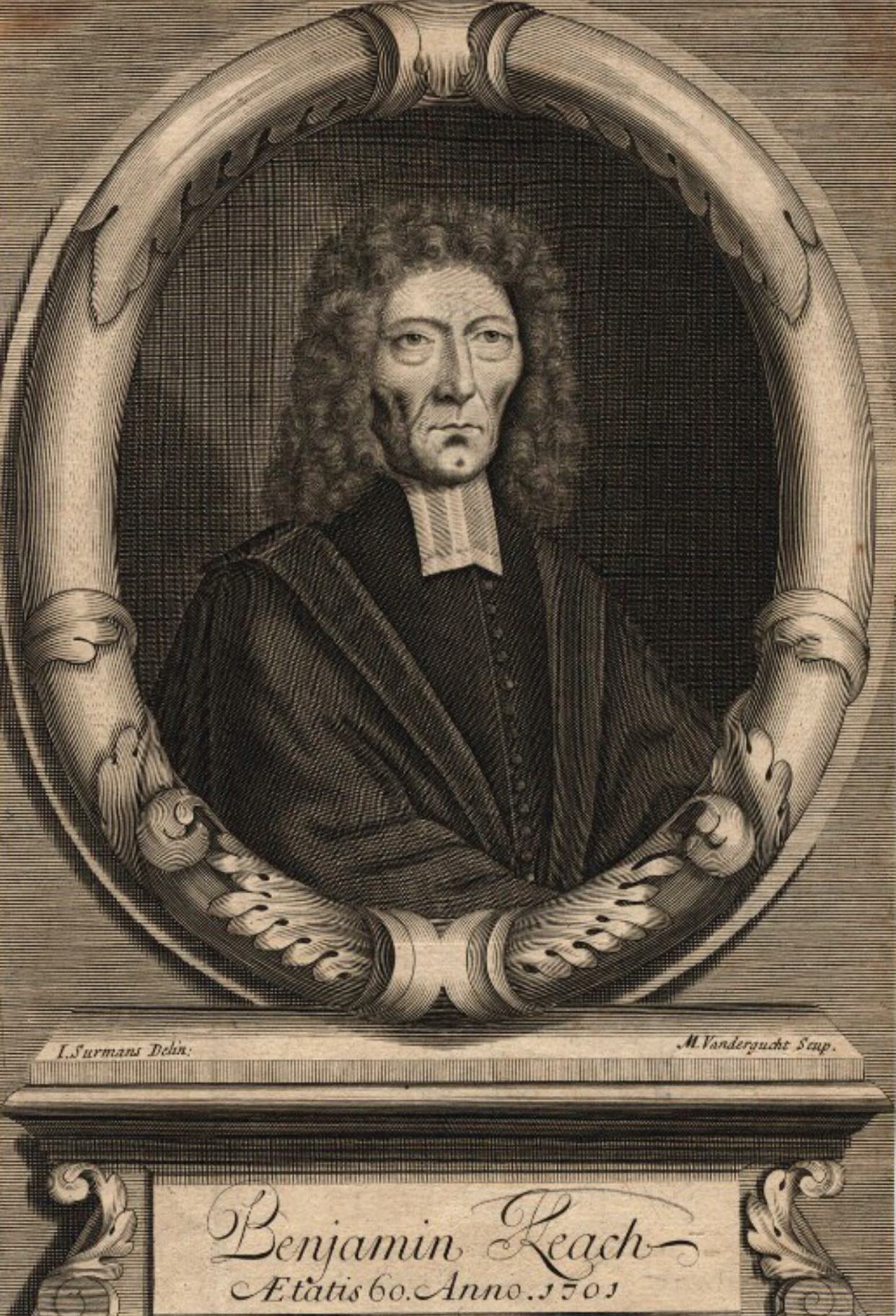
In "Christ a Priest," Benjamin Keach elaborates on the priestly office of Christ, drawing parallels between the Levitical priesthood and Christ's unique role as the High Priest after the order of Melchizedek. Keach argues that while Old Testament priests offered sacrifices for their own sins as well as for the people, Christ's priesthood is without sin and His single sacrifice is sufficient for all mankind (Hebrews 7:26-28; 9:26). He references the necessity of Christ's blood for atonement (Hebrews 9:12), emphasizing its efficacy in cleansing the conscience and providing eternal redemption. This distinction underlines the Reformed assertion that Christ's priesthood is superior and eternally valid, significant for believers who rely on Christ alone for salvation and intercession, contrasting with the Roman Catholic view of ongoing sacrifices.
Key Quotes
“For such an High-Priest becometh us who is holy harmless undefiled separate from sinners and made higher than the heavens.”
“Christ is both Priest and sacrifice. The Divinity or eternal Spirit offered up the humanity as an acceptable sacrifice unto God.”
“Without the blood of Christ offered up as a propitiatory sacrifice to God there is no remission of sin nor eternal life.”
“This greatly detects the ignorance and abominable error of the Romish church that continues to offer up fresh sacrifices for sin as if Christ had not offered up a sufficient sacrifice once for all.”
What does the Bible say about Christ as a Priest?
The Bible confirms that Christ is our eternal High Priest, appointed by God and without sin, making a perfect atonement for our sins.
Hebrews 7:17, Hebrews 7:26
How do we know Christ's priesthood is true?
Christ's priesthood is affirmed through prophetic fulfillment and His unique sacrifice, distinguishing Him from Old Testament priests.
Hebrews 5:4-6, Psalm 110:4, Hebrews 9:26
Why is Christ's priesthood important for Christians?
Christ's priesthood is crucial because He is our mediator who offers a perfect sacrifice and intercedes for us before God.
Hebrews 10:1-4, Hebrews 10:10, Hebrews 7:25
CHRIST A PRIEST
"For he testifieth, thou art a Priest for ever after the order of Melchisedec" Heb 7:17. "For such an High-Priest becometh us, who is holy, harmless, undefiled, separate from sinners, and made higher than the heavens," Heb 7:26.
TYPE
I. The High-priest was taken from among men, but it behoved him not to have any blemish, Le 21:17.
PARALLEL
I. Christ was of the race of Mankind, of the seed of David according to the flesh: "forasmuch as children are partakers of flesh and blood, he likewise himself took part of the same;" but was altogether pure, spotless, without the least stain of sin, Heb 2:14-15; 7:26,28.
TYPE
II. The Priest assumed not to himself this office, but was called to it of God, Heb 5:4. They were consecrated by imposition of hands, when they were twenty five years old. Nu 8:24.
PARALLEL
II. "So Christ glorified not himself, to be made an High-Priest; but he that said unto him, thou art my Son," &c. Ac 13:33. And in another place, "thou art a Priest for ever," &c. Ps 110:4. The Father invested him in this office: "Him hath God the Father sealed," Joh 6:27. He was baptized, and the Spirit came down visibly upon him, when he was about thirty years old.
TYPE
III. The Priests were anointed with oil, and washed with water. "Thou shalt take the anointing oil, and pour it upon his head, and he shall wash his flesh in water," Ex 29:7; Le 16:4.
PARALLEL
III. "Christ was anointed with the oil of gladness above his fellows," Heb 9:9. "How God anointed Jesus of Nazareth with the Holy Ghost, and with power," Ac 10:38. He had also immaculate sanctity and purity in him.
TYPE
IV. The Priest was gloriously clothed; "thou shalt make holy garments for Aaron thy brother for glory and beauty," Ex 28:2.
PARALLEL
IV. Christ was said to be glorious in his apparel clothed with the divine nature as with a garment; he was adorned with perfect and complete righteousness, Isa 63:1-2.
TYPE
V. The Priest was to have a holy crown upon his head, Ex 29:6.
PARALLEL
V. Signifying (saith Mr. Guild) the Deity of Christ, which as a circle hath neither beginning nor end; and the royal dignity, whereby he is advanced to be the supreme Head in all things to his Church, or his Kingship. See Goodwin's Moses and Aaron, Jer 23:5; Eph 1:22; Col 1:18.
TYPE
VI. The Priest's body and loins were to be covered with clean linen.
PARALLEL
VI. Christ's humanity is clothed with true holiness, which is compared to fine linen, clean and white, Re 19:8.
TYPE
VII. The High-Priest bore the names of the tribes of Israel upon his breast, when he went in before the Lord.
PARALLEL
VII. The Lord Jesus, as our High-Priest, presents, or bears the remembrances of all his faithful people upon his heart, when he appears before God to make intercession for them, Heb 7:25. "He knows his own sheep by name," Joh 10:3.
TYPE
VIII. The High-Priest had Urim and Thummim upon his breast.
PARALLEL
VIII. Christ hath in him the perfection of true, light, beauty and holiness. Urim and Thummim signified Christ's prophetical office, whereby he, as a standing oracle to his Church, answers all doubts and controversies whatsoever.[1]
[1] Goodwin's Moses and Aaron, p. 17
TYPE
IX. The High-Priest had an engraven plate of gold: "Thou shalt make a plate of pure gold, and engrave upon it, like the engraving of a signet, HOLINESS TO THE LORD: And it shall be upon Aaron's forehead, that Aaron may bear the iniquity of the holy things; and it shall always be upon his forehead, that they may be accepted before the Lord," Ex 28:36,38.
PARALLEL
IX. Christ is the real Antitype of this engraven plate, in likeness of a signet, holiness to the Lord, in that the Father hath actually communicated to him his nature, who is the express image of his person, a glorious representation of him to us, being able to bear, and hath borne our iniquities: "The Lord hath laid on him the iniquities of us all," Isa 53.
TYPE
X. Aaron the Priest was Moses' mouth to the people.
PARALLEL
X. Christ is the mouth of the Father to the sons of men; he is called "The word of God," Re 19:13, "God hath spoken unto us by his Son," Heb 1:2.
TYPE
XI. The High-Priest 'was not to marry a widow, a divorced woman, nor an harlot, but a chaste virgin, Le 21:14.
PARALLEL
XI. Christ's Church must be a pure virgin, chaste, unstained with superstition or idolatry, giving neither love nor worship to any other: Christ owns none but such a people for his spouse.
TYPE
XII. The Priest's work was to offer sacrifices for the sins of the people: "For every High-Priest is ordained to offer gifts and sacrifices," &c., Heb 8:3.
PARALLEL
XII. Christ offered up his own body, as a sacrifice for our sins: "He appeared to put away sin by the sacrifice of himself. Christ was once offered to bear the sins of many," &c., Heb 9:28.
TYPE
XIII. The Priest was to take the blood of the bullock, and dip his finger in it, and sprinkle seven times the mercy-seat, &c. Le 16:14; and likewise the blood of calves and goats, and he sprinkled the book, and all the people, the tabernacle, and the vessels of the ministry.
PARALLEL
XIII. As Christ was offered upon the cross for the sins of mankind, as a propitiatory sacrifice; so must his blood in a spiritual manner be sprinkled upon our consciences, that we may be cleansed from our sins, and accepted in the sight of God. "Let us draw near with a true heart, in full assurance of faith, having our hearts sprinkled from an evil conscience," &c., Heb 10:22, "For if the blood of bulls and goats, and the ashes of an heifer, sprinkling the unclean, sanctifieth to the purifying of the flesh; how much more shall the blood of Christ, who through the eternal Spirit offered himself to God, purge your consciences from dead works, to serve the living God?" Heb 9:13-14; "But ye are come to mount Zion," &c.---"And to Jesus, the Mediator of the new covenant; and to the blood of sprinkling, that speaks better things than the blood of Abel," Heb 12:22,24.
TYPE
XIV. The Priest's garments were to remain after him, to clothe and adorn his sons withal.
PARALLEL
XIV. Christ's righteousness remains for ever, to clothe and adorn all true believers. It is the wedding-garment, whosoever hath it not, shall be shut out of the marriage-chamber, and cast into utter darkness, Mt 22:12-13.
TYPE
XV. The Priests were to sound the trumpets, which (as Mr. Goodwin observes) were twofold, sometimes an alarm to war, sometimes to assemble the people, Nu 10:4.
PARALLEL
XV. Christ sounds the great trumpet of the Gospel, for the assembling and gathering together of his elect to himself, from all the four quarters of the earth; and will sound an alarm at the last day, to the general judgment. "The trumpet shall sound, and the dead shall be raised," &c., 1Co 15:52.
TYPE
XVI. The Priests of the Lord were to teach the law to the people: "The Priest's lips should keep knowledge, and they should seek the law at his mouth," Mal 2:7.
PARALLEL
XVI. Christ is the great Teacher of God's law; it is he that gives us the knowledge of salvation, that "Guides our feet into the way of peace," Lu 1:79. "We must seek the law, i.e. the mind and will of God, at his mouth, who shows us plainly of the Father. His tabernacle is only standing; not Moses', not Aaron's, not Elias's, but Jesus' s: "This is my beloved Son, hear him," Mt 17:4-5. He is the last and only Teacher sent from God.
TYPE
XVII. The Priest was to judge of the plague of the leprosy, and to pronounce clean, or unclean.
PARALLEL
XVII. Christ is Judge concerning the plague of every man's heart, what sin is deadly, and what not. Though there is no sin venial, as the papists affirm, yet there is much more danger and evil in some sins, than in others. As for example, it is worse to have sin in the affection, than in the conversation; to love it, than to commit it. The best of saints have not been without sin; infirmities have attended them, yet they loved them not. It is a loathsome thing to a true believer: "That which I hate, that do I," Ro 7:15. [2] The Priest was to pronounce a man utterly unclean, if the plague was got into his head: so if a man's judgment, will, and affection, are for the ways of sin; if they choose and love that which is evil, Christ the High-Priest, in his word, pronounces such unclean. When men approve not of God's ways, because they forbid, and give no toleration to their beastly lust and sensuality, and from hence secretly despise religion in the strictness of it; these surely have the plague in their heads.
[2] See Mr. Burrough's spots of the godly, p. 43, 44.
TYPE
XVIII. The Priests under the law made and anointed kings. Jehoiada the Priest, and his sons, anointed Joash king of Judah, 2Ch 23:9-11.
PARALLEL
XVIII. The Lord Jesus makes and anoints many to be kings; for besides his acting towards men, in bringing of them to their thrones and kingdoms, as it is said, "By me kings reign,"Pr 7:15; he makes all his saints "kings and Priests, and they shall reign on earth," Re 5:10.
TYPE
XIX. The Priests were to appoint officers over the house of God; and it did not appertain to the civil magistrate to intermeddle in the Priest's office. See the case of Uzziah, 2Ch 26:20.
PARALLEL
XIX. Christ hath the absolute power of appointing what officers should be in his Church: "He gave some apostles, some prophets, some evangelists, some pastors and teachers," Eph 4:11Those that make any other spiritual office or officer, than Christ hath ordained, will be found grand criminals in the great day.
TYPE
XX. The Priests of the Lord were to bless the people.
PARALLEL
XX. Christ was sent to "Bless the people by turning every one of them from the evil of their ways," Ac 2:26, to give pardon, yea, the Holy Spirit, and eternal life, to as many as believe on him
TYPE
XXI. The High-Priest only went into the holiest of all, and that not without blood, to make atonement.
PARALLEL
XXI. Christ entered into heaven itself alone for us, as Mediator, through the merit of his precious blood, shed to make atonement once for all, "There to appear in the presence of God for us," Heb 9:24. "Neither by the blood of goats and calves, but by his own blood, he entered in once into the holy place, having obtained eternal redemption for us," Heb 9:12.
TYPE
XXII. The High-Priest only made the perfume for burnt-offerings; and it might not be applied to any other use, but to burn before the Lord.
PARALLEL
XXII. Christ only makes the prayers of the saints to come up into the nostrils of God, through his own mediation, as sweet incense; Re 8:3; and no other prayer must be made to God, but such only as the High-Priest directeth us in, Mt 6:8-10.
TYPE
XXIII. The death of the High-Priest set the guilty person, or man-slayer free, who had fled to the city of refuge: "After the death of the High-Priest, the slayer shall return to the land of his possession," Nu 5:28. By the High-Priest's death an atonement was made for him, saith Mr. Ainsworth.
PARALLEL
XXIII. Christ's death makes an atonement for all guilty sinners, that fly to the spiritual city of Refuge, not for the man-slayer only, but for the adulterer, drunkard, and murderer also; all, whoever they be, that take hold of God in Christ by a lively faith, are set at liberty, and for ever delivered from the avenger of blood and all spiritual thraldom whatsoever.
TYPE
XXIV. "The High-Priest brought the bodies of those beasts (whose blood was brought into the sanctuary) to be burnt without the camp," Heb 13:11.
PARALLEL
XXIV. "Jesus also, that he might sanctify the people with his own blood, suffered without the gate, that so we might from thence go forth unto him without the camp, bearing his reproach," Heb 13:12.
TYPE
I. The Jewish High-Priest was taken of the tribe of Levi, and so was after the order of Aaron.
DISPARITY
I. Christ sprung of the tribe of Judah, and not after the order of Aaron, but after the order of Melchisedec. "Wherefore the priesthood being changed, there is of necessity a change of the whole law," Heb 7:12.
TYPE
II. The Jewish High-Priest was made without an oath, and after the law of the carnal commandment.
DISPARITY
II. Christ was made a Priest with an oath: "By so much was Jesus made a Surety of a better covenant," Heb 7:22.
TYPE
III. The High-Priests under the law were men that "Had infirmities, and needed to offer up sacrifices for their own sins," Heb 7:28.
DISPARITY
III. But Christ is an High-Priest without infirmity: "For the law maketh men High-Priests, which have infirmity; but the word of the oath, which was since the law, maketh the Son, who is consecrated for evermore," Heb 7:28. "For such an High-Priest became us, who is holy, harmless, undefiled, separate from sinners, and made higher than the heavens," Heb 7:26.
TYPE
IV. The Priests under the law offered up sacrifices of sin continually: "Every Priest standeth daily, ministering or offering often the same sacrifices, which cannot take away sins," Heb 10:11.
DISPARITY
IV. "Christ having offered up but one sacrifice for sin, sat down at the right-hand of God." Nor yet that he should offer himself often, as the High-Priest entereth into the holy place,---for then must he have often suffered since the foundation of the world; but now at the end of the world hath he appeared to take away sin, by the sacrifice of himself," Heb 9:26. "Christ once suffered to bear the sins of many," &c. "By one offering he hath perfected for ever them that are sanctified," Heb 10:14.
TYPE
V. The Priests under the law offered up the bodies of beasts, and it was impossible that the blood of bulls and of goats could take away sin, or purge the conscience, or make the comers thereunto perfect." Hence it is said, there was a "Remembrance for sin every year," Heb 10:1-3.
DISPARITY
V. Christ offered up his own body, which was the Antitype of all those legal sacrifices: "By which we are sanctified, through the offering up the body of Christ once for all," Heb 10:10. Those sacrifices cleansed only ceremonially: "The law made nothing perfect, but the bringing in of a better hope did," Heb 7:19. "Christ's blood, who through the eternal Spirit offered himself without spot to God, purges the conscience from dead works, to serve the living God," Heb 9:14. "The blood of Christ cleanseth us from all sin," 1Jo 1:7.
TYPE
VI. The High-Priest under the law had a successor; there were many because they were not suffered to continue by reason of death," Heb 7:23.
DISPARITY
VI. "Christ, because he continueth forever, hath an unchangeable Priesthood," Heb 7:24. He hath none, needeth none, can have none to succeed him in the Priesthood, "seeing he ever liveth," and hath taken the whole work upon himself, being infinitely able and sufficient to discharge the whole trust reposed in him.
TYPE
VII. The Priest under the law, and the sacrifice, were two things.
DISPARITY
VII. Christ is both Priest and sacrifice. The Divinity, or eternal Spirit, offered up the humanity as an acceptable sacrifice unto God.
TYPE
VIII. The Priest under the law entered into the holy place, by the blood of bulls and calves.
DISPARITY
VIII. "Christ entered into the holiest by his own blood, having obtained eternal redemption for us," Heb 9:12.
TYPE
IX. The Priest under the law offered sacrifices only for the Jewish nation, or Israel according to the flesh.
DISPARITY
IX. Christ offered up a sacrifice both for Jews and Gentiles. "He is a propitiation for our sins, and not for ours only, but for the sins of the whole world," 1Jo 2:2.
COROLLARIES.
I. FROM hence we may learn, that without the blood of Christ offered up as a propitiatory sacrifice to God, there is no remission of sin, nor eternal life. God's wrath is only appeased by a sacrifice; and this was clearly hinted from the beginning.
II. From hence we may learn, how far the Priesthood of Christ, and the Gospel-covenant doth excel that of the law; moreover, the end and design of God in the one, and in the other. Many things have been briefly touched, wherein the great differences do consist; some of which, for the sake of the weak, I shall reiterate in this place. The Priest under the law was a mortal man; Christ God-man. Those Priests were sinners themselves, and needed a sacrifice for their own sins; Christ was without sin, and needed no offering for himself, Christ offered up his own body on the tree. Those sacrifices were the shadow; the sacrifice of Christ is the substance of them. The Priest and sacrifice is the type, Christ the Antitype. Those sacrifices could not take away sin, nor purge the conscience; Christ's sacrifice doth both.
III. Moreover, this reprehends such as slight and invalidate the meritorious sacrifice of Christ, and accounts his blood to have no more virtue nor efficacy in it to justification, than the blood of any godly man.
IV. It also calls upon all faithful Christians, to study the nature of Christ's Priesthood more and more; much of the mystery of the two covenants consisteth in Priesthood, and sacrifice, there is something in it hard to be understood.
V. This greatly detects the ignorance and abominable error of the Romish church, that continues to offer up fresh sacrifices for sin; as if Christ had not offered up a sufficient sacrifice once for all, or that he needeth competitors, and help, to atone and make peace between God and sinners.
VI. It may also confute their blasphemous notion concerning Christ's Priesthood as if it passed from him unto them; whereas nothing can be more plainly asserted, than his continuing a Priest for ever. His Priesthood is unchangeable, exercised in his own Person, as a principal part of the glory of his office; and on the discharge of it, depends the Church's preservation and stability: "He ever liveth to make intercession for us," Heb 7:25. And every believer may from hence go with confidence unto him in all their concerns, for relief and succour, who himself is said to be "touched with the feeling of our infirmities," Heb.iv.15.
But this of Christ's offering once for all, and continuing a Priest for ever, the Rhemish annotators are greatly at a loss about, concluding, that it makes against the Jews and Aaron's Priesthood; which worthy Cartwright learnedly answers, to whom we refer you. For clear it is, that what the papists affirm concerning their Priest and mass to be a propitiatory sacrifice for the quick and the dead, is detected from hence to be a blasphemous, execrable, and pestilent error; and by no means are they able to make the offerings and sacrifices made by their Priests as Christ's successors, to hold good in any case, or consonant to God's word. Which further to evince, we shall here cite a page of Dr. Owen's, on Heb 7:24; and so conclude this of Christ's Priesthood.
"The expositors of the Roman Church are greatly perplexed in the reconciling of this passage of the apostle unto the present Priesthood of their Church; and they may well be so, seeing undoubtedly they are irreconcilable. Some of them say that Peter succeeded unto Christ in his Priesthood, as Eleazar did unto Aaron; so Ribera. Some of them deny that he hath any successor, properly so called: Successorem non habet, nec ita quisquam Catholicus loquitur, si bene and circumspecte loqui velit, saith Æstius. But it is openly evident, that some of them are not so circumspect as Æstius would have them, but do plainly affirm, that Peter was Christ's successor. A. Lapide indeed affirms, that Peter did not succeed unto Christ, as Eleazar did unto Aaron, because Eleazar had the Priesthood in the same degree and dignity with Aaron, and so had not Peter with Christ; but yet that he had the same Priesthood with him, a Priesthood of the same kind, he doth not deny.
"That which they generally fix upon is, that their Priests have not another Priesthood, or offer another sacrifice, but are partakers of his Priesthood, and minister under him, and so are not his successors, but his vicars; which I think is the worst composure of this difficulty they could have thought upon: for,
"1. This is contrary unto the words and design of the apostle; for the reason he assigns, why the Priesthood of Christ doth not pass from him to any other, is, because he abides himself for ever to discharge the office of it. Now this excludes all subordination and conjunction, all vicars, as well as successors; unless we shall suppose, that although he doth thus abide, yet he is one way or other disabled to discharge his office.
"2. The successors of Aaron had no more another Priesthood, but what he had, nor did they offer any other sacrifice than what he offered, as these Priests pretend to offer the same sacrifice that Christ did: so that still the case is the same between Aaron and his successors, and Christ and his substitutes.
"3. They say, that Christ may have substitutes in his office, though he abide a Priest still, and although the office still continue the same unchangeable: so God, in the government of the world, makes use of judges and magistrates, yet is himself the supreme Rector of all. But this pretence is vain also: for they do not substitute their Priests unto him, in that which he continueth to do himself, but in that which he doth not, which he did indeed, as a Priest ought to do, but now ceaseth to do for ever in his own Person; for the principal act of the sacerdotal office of Christ consisted in his oblation, or his offering himself a sacrifice of a sweet-smelling savour unto God. This he did once, and ceaseth for ever from doing so any more: but these Priests are assigned to offer him in sacrifice every day, as partakers of the same Priesthood with him, which is indeed not to be his substitutes, but his successors, and to take his office out of his hand, as if he were dead, and could henceforth discharge it no more: for they do not appoint Priests to intercede in his room, because they grant he continueth himself so to do, but to offer sacrifice in his stead, because he doth so no more. Wherefore if that be an act of Priesthood, and of their Priesthood, as is pretended, it is unavoidable that his Priesthood is passed from him unto them. Now this is a blasphemous imagination, and directly contrary both unto the words of the apostle, and the whole design of his argument; nay, it would lay the advantage on the other side; for the Priests of the order of Aaron had that privilege, that none could take their office upon them, nor officiate in it, whilst they were alive; but although Christ abideth for ever, yet, according to the sense of these men, and their practice thereon, he stands in need of others to officiate for him, and that in the principal part of his duty and office. For to offer himself in sacrifice unto God, he neither now doth, nor can, seeing henceforth he dieth no more. This is the work of the mass-Priests alone, who must therefore be honoured as the successors of Christ, else be abhorred as his murderers; for the sacrifice of him must be by blood death.
"The argument of the apostle, as it is exclusive of this imagination, so it is cogent unto this purpose; for so he proceedeth: that Priesthood which changeth not, but is always vested in the same person, and in him alone, is more excellent than that which was subject to change continually from one hand to another; for that transmission of it from, one unto another, was an effect of weakness and imperfection. And the Jews grant, that the frequency of their change under the second temple was a token of God's displeasure. But thus it was not with the Priesthood of Christ, which never changeth, and that of Aaron, which was always in a transient succession. And the reasons he gives of this contrary state of these two Priesthoods, do greatly enforce the argument: for the first Priesthood was so successive, because the Priests themselves were obnoxious unto death, the sum and issue of all weaknesses and infirmities. But as to the Lord Jesus Christ, his Priesthood is perpetual and unchangeable, because he abideth personally for ever: "Being made a Priest according to the power of an endless life, which is the sum of all perfection that our nature is capable of."

Comments
Your comment has been submitted and is awaiting moderation. Once approved, it will appear on this page.
Be the first to comment!