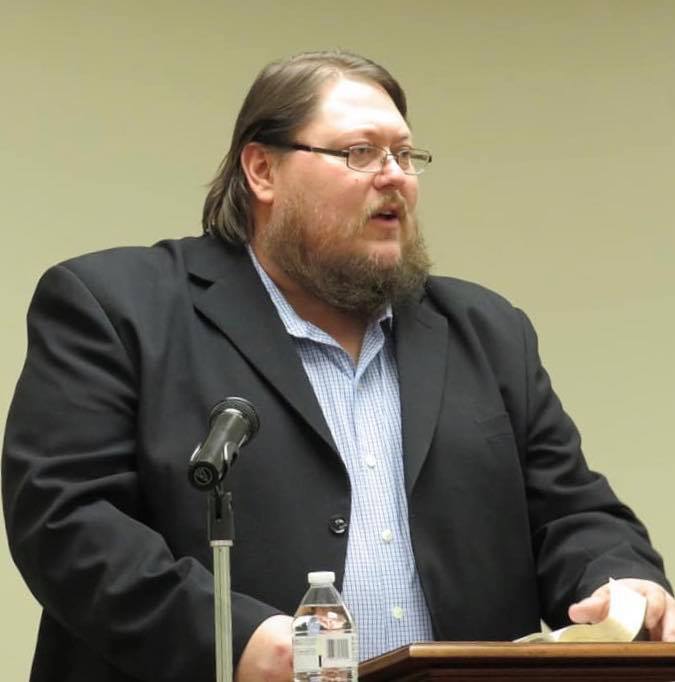
In the sermon "Origin of the Church Pt 5," Mikal Smith addresses the theological doctrine of the church's origin and perpetuity, arguing that the church was established during Jesus Christ's earthly ministry rather than at Pentecost or through Abraham. He emphasizes that the church is a local, visible assembly of believers, rejecting concepts of a universal or invisible church. Smith supports his arguments with Scripture references, particularly Matthew 16:18 where Jesus promises that the gates of hell will not prevail against the church, asserting its perpetual existence throughout history. This view holds significant doctrinal implications for the Reformed understanding of ecclesiology, emphasizing the necessity of local congregations in preserving Christ's teachings and practices through the ages.
Key Quotes
“The church is not an age-long institution of elect... but that the church is a local, visible assembly.”
“The gates of hell shall not prevail against it.”
“If there is perpetuation of the faith, it's going to be in the local church, not outside of it.”
“The church, Christ’s congregation, is the pillar and ground of truth.”
The Bible indicates that the church began with Jesus' earthly ministry, not at Pentecost or prior.
According to Matthew 16:18, Jesus declared, 'Upon this rock I will build my church,' indicating that the church's foundation and origin lie in His ministry and the calling of the apostles. This truth counters popular beliefs suggesting that the church began at Pentecost, with John the Baptist, or even with Abraham. The church's existence predates Pentecost, beginning at Jesus' baptism, during which He started gathering His followers into a local, visible assembly. This assembly, comprised of believers 'elected of God,' was characterized by scriptural baptism and focused on the doctrine and practice of Christ.
Matthew 16:18
Christ's promise in Matthew 16:18 affirms that the gates of hell will not prevail against His church, suggesting its ongoing existence.
In Matthew 16:18, Jesus assures that 'the gates of hell shall not prevail against it,' a promise affirming the church's continuity throughout history. The church is not merely a historical artifact; it actively maintains the doctrine and practices given by Christ. Historical documentation shows that various groups, from the early Waldensians to modern-day Baptists, have maintained the integrity of the gospel. This continuity through the ages highlights the importance of a local assembly that is governed by Christ's teachings and remains true to His foundational principles.
Matthew 16:18, Matthew 28:20
Local churches preserve the teachings of Christ and are where believers gather for worship and instruction.
Jesus established the local church as the 'pillar and ground of the truth' (1 Timothy 3:15). Participating in a local assembly allows Christians to engage in proper worship, receive instruction in doctrine, and exercise their spiritual gifts. Declining involvement in the local church not only denies believers the opportunity to follow Christ's commandments but also undermines the church's role in maintaining doctrinal integrity. The local church is essential for mutual support and accountability as believers gather to fulfill the Great Commission.
1 Timothy 3:15, Matthew 28:20
The church has maintained its teachings through a lineage of faithful congregations and documented history.
Historical records show that from the time of Christ, churches have faithfully preserved the doctrine and practice of the New Testament. Groups throughout history, such as the Waldensians and Anabaptists, are noted for their adherence to the original teachings of Christ and the apostles. This preservation is vital, as it ensures that the church remains a credible witness of the gospel. With a commitment to the teachings of Christ, churches offer continuity of belief and practice that aligns with God's Word across generations.
1 Timothy 3:15, Matthew 16:18
Comments
Your comment has been submitted and is awaiting moderation. Once approved, it will appear on this page.
Be the first to comment!
